Wagh Bakari
Traditional Sport of India
Wagh Bakari / Goat and the Tiger
Wagh Bakari is a traditional outdoor group game in which one player becomes the tiger, another becomes the goat, and the remaining players form a protective circle. The game is lively, symbolic, and cooperative, as it recreates the chase between predator and prey through movement, rhythm, and teamwork.
About the Game
Wagh Bakari is played as a dramatic chase game in which a tiger tries to catch a goat while a ring of players protects the goat by forming a moving barrier.
The game encourages teamwork, alertness, cooperation, and playful strategy, making it well suited for schools, village grounds, and community gatherings.
Introduction
The game represents the timeless struggle between danger and protection, with the goat depending on the group for safety and the tiger searching for an opening.
It is both physical and musical, as players often begin with a rhythmic local call such as “Wagh Bakri!” and continue with chants that keep the group coordinated and engaged.
The Setup
Playground
The game is best played on open ground such as a schoolyard, grassy field, or large courtyard with enough space for free movement.
Players
It is usually played by 10 to 16 participants, generally aged 6 years and above.
Safety
The play area should be free from stones, sharp objects, or obstacles, and all tagging should be gentle and controlled.
Game in Action
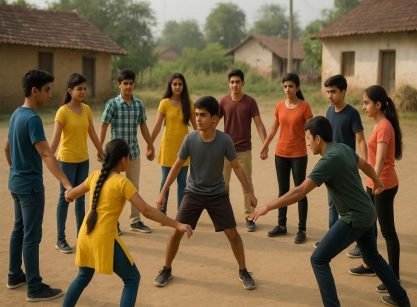
The Play
- A group of players stands in a large circle while holding hands.
- One player is chosen as the Goat and stands inside the circle.
- Another player becomes the Tiger and stands outside the circle.
- The game begins with a chant or signal call.
- The tiger tries to enter the circle and tag the goat.
- The circle players move together, lifting or lowering their linked hands to block entry.
If the tiger gets inside, the goat must escape quickly while the circle closes again to trap or delay the tiger.
Winning Conditions
If the tiger touches the goat within the set time, the tiger wins the round.
If the goat avoids being tagged until time runs out, the goat wins. After each round, players switch roles so that everyone can experience being the tiger, the goat, and the protective circle.
Chants and Rhythm
Traditional versions of the game often include short, repetitive folk chants that vary from region to region.
These songs help synchronize movement, increase excitement, and turn the game into a shared musical activity rather than only a chase game.
Educational Values
Game Skills
- Team cooperation through coordinated circle movement.
- Alertness and strategy for both the tiger and the goat.
- Quick reaction and spatial awareness.
- Balance between attack and defense.
Life Lessons
- Cultural bonding through traditional chants and shared play.
- Fairness through role exchange.
- Empathy by experiencing both hunter and protected roles.
- Respect for group coordination and mutual support.
Reflection for Players
After the game, players can reflect on how teamwork helped protect the goat and how the circle worked as a unit.
They can also discuss what the tiger learned about timing, patience, and respecting the boundaries created by the group.