Valay Dand (Ring Goal)
Traditional Sport of India
Valay Dand / Ring Goal
Valay Dand, also known as Ring Goal, is a traditional team game associated with Maharashtra and Gujarat, where players pass a ring by hand and attempt to score through a pole-based goal. It is known in community sports and youth activity settings for encouraging teamwork, coordination, and fast decision-making. [web:147][web:150][web:153][web:156]
About the Game
Valay Dand is a traditional Indian outdoor team sport centered on passing a ring quickly and accurately among teammates. The aim is to create an opening and place or throw the ring into a goal formed by a pole held in the goal area.
Its simple equipment and cooperative nature make it easy to organize in school grounds, open fields, and physical training gatherings. The game rewards alert movement, clean passing, and disciplined team play.
Origin
Valay Dand is commonly linked with community play traditions in Maharashtra and Gujarat, and it also appears in organized traditional game activities and shakha-style sports practice. Available public references show it being demonstrated and played in youth and cultural sports settings, though detailed formal historical documentation is limited. [web:147][web:150][web:153][web:156]
The name reflects the equipment used in the game: Valay means ring, while Dand refers to the pole or stick used as the goal target.
Game in Action
The Setup
Equipment Needed
- A small ring made of rubber, plastic, or light metal.
- A goal pole or wooden stick, usually held by a designated player.
Play Area
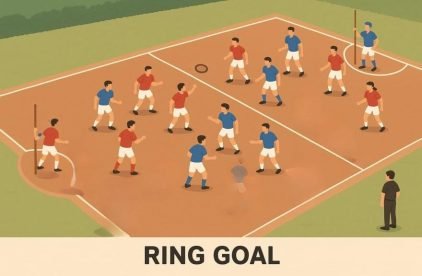
The game is played on an open field divided into two halves, with a marked goal area at each end.
Players
Two teams take part, usually with 5 to 10 players each. One player from each team serves near the goal area, while the remaining players act as passers, movers, and defenders.
The Play
The objective is to move the ring through coordinated hand-passing and then complete a successful goal at the target pole.
Starting the Game
- The match begins with a toss.
- The winning team starts with possession of the ring.
Passing the Ring
- Players may use only their hands to pass the ring.
- A player must stop moving after catching the ring.
- The ring should then be passed quickly to another teammate.
Movement Rules
- Players without the ring can move freely around the field.
- Players holding the ring must remain stationary while passing.
Defense and Interception
- Opponents can intercept passes.
- Physical contact, pushing, or rough blocking is treated as a foul.
Scoring a Goal
- A goal is scored when the ring is placed or thrown successfully into the pole-based goal.
- The goal player must remain within the marked goal area.
- The scoring move must be completed without a foul.
Rules
- The game starts with a toss, and the winner gets the first possession.
- Passing is done only by hand.
- A player holding the ring cannot run with it.
- Players without the ring may move freely to create space or defend.
- Only interception is allowed in defense; body contact is not allowed.
- Common fouls include moving with the ring, holding it too long, and touching opponents illegally.
- After a goal, play restarts with the non-scoring team from the center or a neutral restart point.
Duration and Scoring
A match may be played for a fixed time, such as 15 to 20 minutes, or until a team reaches a pre-decided number of goals.
| Action | Result |
|---|---|
| Successful goal | 1 point |
| Foul | Possession change or agreed penalty |
| Tie | Extra time or penalty round |
Skills and Strategies
Core Skills
- Agility for quick positioning and support movement.
- Observation to anticipate passes and interceptions.
- Accurate timing in catching and releasing the ring.
- Aim and goal awareness near the scoring zone.
Team Strategy
- Create open passing lanes.
- Move without the ring to support the next pass.
- Maintain spacing to avoid easy interception.
- Use coordinated passing to reach the goal area safely.
Lessons from the Game
Valay Dand teaches that success in team games depends on cooperation, timing, and trust rather than individual effort alone.
It also reinforces discipline, fair play, patience, leadership, and respect for shared rules—qualities that make traditional games valuable beyond recreation.