Tekeli Bhonga Khel – Assam
Traditional Sport of India
Mitdel Khuangvuak / Tekeli Bhonga
Mitdel Khuangvuak, widely known in Assam as Tekeli Bhonga, is a traditional blindfold striking game played with an earthen pot and a stick. It is a lively folk activity that blends fun, listening skill, balance, and community participation, especially during festive village gatherings.
About the Game
Tekeli Bhonga is a traditional Assamese game in which a blindfolded player tries to locate and break an upside-down earthen pot using a stick. The game is simple in setup but exciting in play, as success depends on direction sense, listening, and controlled movement.
It is commonly enjoyed by children as well as adults and is especially popular during village celebrations and festive gatherings.
Introduction
Tekeli Bhonga has been played in Assamese villages for generations and is closely connected with community life. The earthen pot used in the game reflects everyday agrarian culture, where clay utensils were once a common part of household life.
During Bohag Bihu, the Assamese New Year festival, the game often becomes a cheerful public attraction in open fields, with spectators clapping and encouraging the blindfolded player.
The Setup
Materials Required
- One earthen pot, with extra pots if multiple rounds are planned.
- A bamboo or wooden stick about 3 to 4 feet long.
- A cloth strip about 2 to 3 feet long for blindfolding.
Playing Area
The pot is placed upside down on the ground, usually inside a marked circle. A starting line is drawn about 10 to 15 feet away, depending on the age and skill of the players.
Players
The game can be played individually or in teams. Usually, around 5 to 10 participants take part in one round while others watch, cheer, and judge.
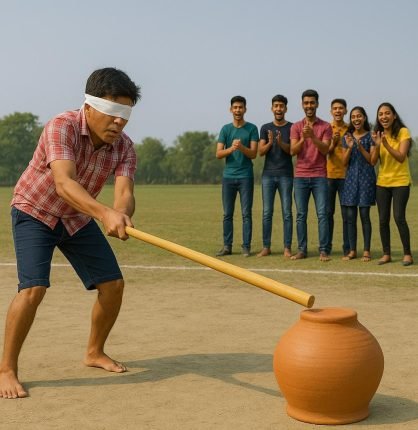
Traditional Play Scene
The Play
Blindfolding the Player
The player’s eyes are covered with a cloth so that they cannot see. They are then gently spun around a few times to disturb their sense of direction.
The Challenge
Holding the stick, the player walks from the starting line toward the area where the pot is placed. Since the player cannot see the pot, they depend on cheering, clapping, and general sound cues from the group.
When the player feels close enough, they swing or strike downward in an attempt to hit and break the pot.
Winning
If the player successfully strikes and breaks the pot, they win the round.
If they miss, the turn passes to the next player. In team versions, the side with the most successful strikes wins.
Rules
- The player must stay blindfolded for the full turn.
- The stick must be swung or struck, not thrown.
- Players should not receive direct instructions like “left” or “right.”
- Each player gets only one attempt per turn.
- The area around the pot should be kept clear.
- The pot must be placed upside down before each round begins.
Safety Measures
- Keep spectators at a safe distance from the striking zone.
- Use a light bamboo stick rather than a heavy one.
- Remove broken pot pieces carefully after each round.
- Do not spin the player too fast or too many times.
Educational Value
Physical and Sensory Skills
- Develops coordination and body control.
- Improves spatial awareness.
- Strengthens listening-based response.
Personal and Social Skills
- Builds focus and patience.
- Encourages fair play.
- Creates joy through shared participation and cheering.
Cultural Significance
Tekeli Bhonga represents the festive and communal spirit of Assam, where simple household objects become the center of playful competition and collective celebration.
It preserves an older village tradition in which games were woven into festivals, local identity, and shared rural life.