Sohkymtoi / Shyieng – Meghalaya
Traditional Sport of India
Sohkymtoi / Shyieng / Dal Ubu
Sohkymtoi, also known as Shyieng in Meghalaya, and Dal Ubu from Arunachal Pradesh are traditional seed-striking games played by children. Using simple objects such as tamarind seeds, pebbles, or broken tile pieces, these games build precision, patience, and concentration through careful finger control.
About the Game
These are traditional children’s games that use very simple local materials instead of expensive toys or equipment. They are usually played on flat ground, verandas, or school floors, especially during leisure time.
Though simple in appearance, the games involve close observation, controlled striking, and thoughtful choice of targets. Their real value lies in the way they develop both motor and emotional discipline through play.
Introduction
Sohkymtoi and Dal Ubu are typically played by children in the age group of about 6 to 8 years. They are especially suited to quiet group play and need only seeds, pebbles, or similar small objects.
In Khasi usage, Sohkymtoi is understood in the sense of “strike and gain,” highlighting the importance of accurate hitting and successful collection. Dal Ubu similarly refers to controlled striking or tapping motion in local tradition.
The Setup
Playing Surface
A smooth and flat surface is needed, such as a mud floor, veranda, courtyard, or classroom floor.
Playing Pieces
Players use about 20 to 30 tamarind seeds, small pebbles, tile fragments, or broken china pieces.
Players
The game is usually played by 3 or 4 children, often in short rounds of about 10 to 15 minutes.
Traditional Seed Play
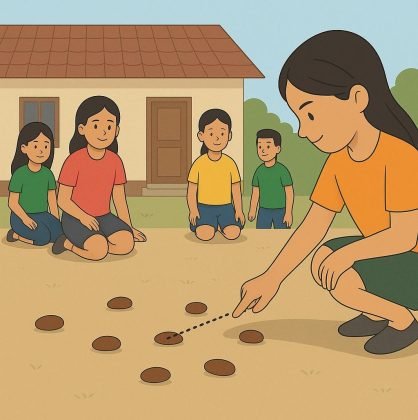
The Play
- The first player scatters the seeds or pieces evenly across the playing surface.
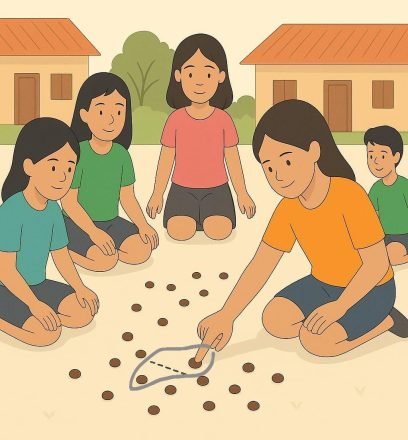
- She selects two suitable pieces and plans a strike between them.
- Before striking, the finger is guided through the imagined line between the chosen pieces.
- The player then strikes one seed toward the other with controlled finger movement.
- If the strike is successful, the player collects both seeds.
- If the attempt fails or disturbs other pieces, the turn passes to the next player.
The game continues until all seeds have been collected. The player with the highest collection wins.
Rules
- A player loses the turn if the finger touches any seed other than the chosen pair.
- The turn also ends if the striking seed hits an unintended seed.
- If there is not enough space to make a proper striking line, the move is not valid.
- The game rewards careful planning and discourages careless or rushed movement.
Precision in Play
Benefits
Motor and Cognitive Benefits
- Enhances fine motor coordination and finger dexterity.
- Improves wrist flexibility and movement control.
- Encourages planning, problem-solving, and decision-making.
Emotional and Social Benefits
- Builds patience and self-control.
- Encourages turn-taking and respect for others.
- Provides enjoyment, relaxation, and calm group interaction.
Life Skills Learned
- Carefulness through attention to detail.
- Decision-making through strategic choice of target seeds.
- Risk judgment through balancing confidence and precision.
- Perseverance through repeated attempts and gradual improvement.
- Joy in simple play through intrinsic satisfaction rather than equipment-based entertainment.
Cultural Significance
Sohkymtoi and Dal Ubu show how traditional childhood play in northeastern India emerged from everyday materials and community spaces. These games preserve local language, style of play, and social learning in a quiet but meaningful form.
They remind us that traditional games can be small in scale yet rich in skill, emotion, and cultural value.