Sepak Takraw
Traditional Sport of India
Sepak Takraw
Sepak Takraw is a fast-paced net sport in which players use the feet, knees, chest, shoulders, and head to send a woven ball over the net without using their hands. It blends elements of football, volleyball, and acrobatic kicking, making it one of the most dynamic traditional sports of Asia.
Introduction
The name Sepak Takraw combines two words: sepak, meaning kick, and takraw, referring to the woven ball used in the game. The sport is especially associated with Southeast Asia and is known for its spectacular kicks, jumps, and aerial control.
Though not as widely known in India as some other traditional sports, it gained visibility when it appeared as a demonstration sport at the 1982 Asian Games in Delhi.
Sport in Action
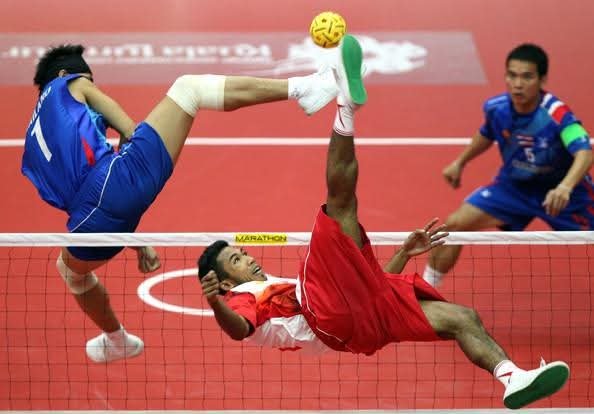
Objective
The main goal is to send the ball over the net into the opponent’s court and prevent it from touching the ground on your own side.
A team scores when the opponent fails to return the ball properly or commits a fault.
Players
Sepak Takraw is commonly played in the Regu format with 3 players on each team. It can also be played in a doubles format with 2 players on each side.
Positions
Tekong
The server who starts play from the service circle.
Setter
The player who controls and places the ball for attack.
Forwards / Attackers
Players near the net who spike, block, and pressure the opposing side.
Equipment
- A Sepak Takraw ball, traditionally woven from rattan and now often made from synthetic material.
- A net similar in style to a badminton net.
- A court similar in size and layout to a badminton court.
The net is generally set at about 1.52 meters for men and about 1.42 meters for women.
Court
The standard court is similar to a badminton court and measures about 13.4 meters by 6.1 meters. It includes a center net and service circles used for starting play.
Gameplay
- A toss decides which team serves first.
- The Tekong begins play by serving the ball over the net.
- Each team may touch the ball up to 3 times before returning it.
- Players use only legal body parts such as the feet, knees, chest, shoulders, and head.
- The rally continues until a point is scored.
Rules of Play
- The server must remain properly positioned inside the service area during the serve.
- Hands and arms cannot be used to hit the ball.
- No team may touch the ball more than three times before sending it across.
- A player should not play the ball twice in immediate succession in the standard team sequence described.
Scoring
Points are awarded when the opponent fails to return the ball, sends it out of bounds, commits a fault, or lets it drop.
Matches are typically played in sets to 21 points, often in a best-of-three format.
Key Techniques
Attacking Skills
- Serving with accuracy and control.
- Setting the ball for a teammate.
- Spiking with powerful acrobatic kicks.
Defensive Skills
- Blocking near the net.
- Returning difficult balls with feet, chest, or head.
- Anticipating opponents’ attacks quickly.
Common Faults
- The ball lands outside the boundary lines.
- The ball does not cross the net.
- A player touches the net during play.
- A player uses hands or arms to contact the ball.
- The team exceeds the allowed number of touches.
Tips for Success
- Develop flexibility and agility for high kicks and aerial control.
- Practice timing and clean ball contact.
- Build strong team coordination and communication.
- Improve defensive reading to respond to fast attacks.
Benefits of Playing
Physical Benefits
- Improves agility, balance, and reflexes.
- Builds coordination and lower-body control.
- Enhances flexibility and athletic movement.
Social Benefits
- Encourages teamwork and tactical understanding.
- Promotes discipline and communication.
- Creates exciting play for both participants and spectators.
Note
Sepak Takraw is a thrilling sport that transforms kicking skill into a refined team game of speed, rhythm, and airborne control. Its blend of athletic grace and competitive intensity makes it one of the most visually striking traditional sports in Asia.