Randos
Traditional Sport of India
Randos
Randos is a traditional outdoor game from Meghalaya that combines batting, running, aiming, and team strategy. Played with stones, a bat, and a ball, it reflects the creativity of village sports where simple materials create energetic and skillful play.
About the Game
Randos is a traditional game played by children and youth in the hilly regions of Meghalaya. It blends the fun of striking a ball with the challenge of running a circuit and avoiding dismissal.
The game is simple to organize and can be played in open fields, school grounds, or village courtyards. It highlights physical fitness, quick judgment, and group cooperation.
Origin
Although its exact historical origin is not formally documented, Randos has long survived through oral tradition and community practice in Meghalaya. It appears to have grown from local play culture using easily available materials such as stones, bamboo sticks, and homemade balls.
Over time, the game became part of after-school recreation, village gatherings, and youth activities. It stands as an example of indigenous sporting creativity rooted in rural life.
The Setup
Materials Needed
- Four large stones, roughly football-sized.
- A wooden bat or bamboo stick.
- A rubber ball, or a softer paper or straw ball for younger children.
The Playground
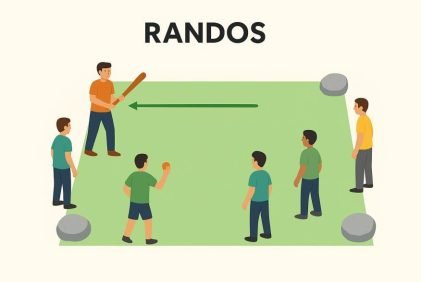
Four stones are placed to form a square, usually about 10 to 12 feet apart. This square forms the main Randos field.
One point is marked as the starting or base point where the batsman begins. The space outside the stone square is used by the fielding team.
Players and Teams
The game is generally played by two teams of nine players each. One team bats first while the other takes fielding positions outside the square.
Traditional Play Scene
The Play
- The batting team sends one batsman into the stone boundary to begin.
- The fielding team stands outside the boundary at chosen positions.
- A fielder throws the ball toward the batsman.
- The batsman hits the ball with the bat and sends it away from the field.
- After hitting, the batsman runs to each of the four stones, touching them with the bat, and returns to the starting point.
- Completing this full circuit scores one run.
If the batsman misses the ball, no run can be attempted and the ball is thrown again. The batsman continues until declared out.
How a Player Gets Out
- If the fielders hit the target stone with the ball before the batsman reaches it, the batsman is out.
- If the batsman steps outside the boundary improperly or fails under the agreed rules, the turn may end.
- The fielders may pass the ball among themselves to get a better throwing chance.
Once all batsmen of the first team are out, the second team begins its batting turn.
Rules
- The batsman must hit the ball before attempting to run.
- The four stones must stay in their fixed positions throughout the game.
- No blocking, pushing, or rough physical contact is allowed.
- For children, underarm throws are safer and preferred.
- Substitutes may be allowed only by agreement between both teams.
Scoring System
| Action | Result |
|---|---|
| Complete one full circuit and return | 1 run |
| Hit the ball but fail to complete the circuit | 0 run |
| Ball hits the target stone before arrival | Out |
| Team result | Total of all individual runs |
The team with the higher total after both sides have batted wins the game.
Safety Measures
- Use a soft rubber, paper, or straw ball for younger players.
- Make sure the ground is flat and free from holes or dangerous objects.
- Avoid overarm throws and rough play.
- Younger groups should be supervised by teachers, parents, or elders.
Benefits of Playing Randos
Physical and Mental Skills
- Builds strength, coordination, and reflexes.
- Encourages fast running and active movement.
- Improves decision-making under pressure.
- Develops confidence and risk judgment.
Social Benefits
- Promotes teamwork and communication.
- Encourages patience and fair participation.
- Creates joy, shared excitement, and emotional well-being.
Cultural Significance and Life Lessons
Randos reflects how communities in Meghalaya transformed simple natural materials into meaningful games. It preserves a style of play rooted in open spaces, shared effort, and local resourcefulness.
The game also teaches courage balanced with caution, as players must constantly decide whether to run, wait, or act quickly. Through this, children learn resilience, teamwork, and the rhythm of success and setback.
Notes
Randos is a fine example of India’s traditional sports heritage: modest in equipment, rich in skill, and full of life lessons. It strengthens the body, sharpens the mind, and keeps community play traditions alive.