Pretwa
Traditional Sport of India
Pretwa
Pretwa is a traditional board game from Bihar played on a circular grid of concentric circles and connecting lines. Often described as “checkers on a wheel,” it combines movement, jumping, capture, and positional strategy in a strikingly geometric form.
About the Game
Pretwa is a traditional Indian board game in which two players move pieces on a circular network of lines and intersections. It resembles draughts or checkers in its jumping and capturing style, but its circular board makes play feel more fluid and strategic.
The game rewards planning, patience, and pattern recognition. Because pieces can move along circles and radial connections, players must think not only in straight lines but also in curved spatial relationships.
Traditional Board Form
Origin
Pretwa is associated with the traditional game culture of Bihar, where strategic board games formed an important part of leisure, learning, and social interaction. It belongs to the wider Indian heritage of intellectual games that combine simple materials with deep tactical play.
The name is linked with the idea of opposition or facing an opponent, reflecting the game’s competitive and tactical nature. Its circular design gives it a distinctive identity among Indian board games.
The Setup
The Board Design
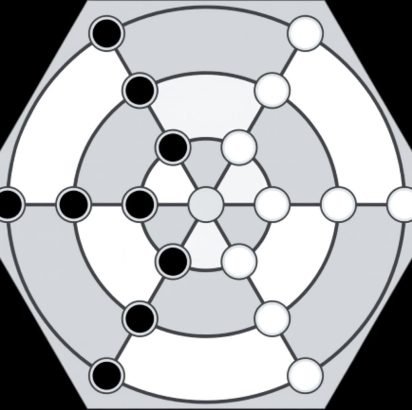
The Pretwa board consists of three concentric circles connected by radial lines. These intersections create movement points where pieces can travel or capture.
Players may move along the circular paths or across the connecting spokes, which creates a sense of continuous motion and changing lines of attack.
Equipment
Board
A Pretwa board drawn on the ground or made on wood with circular and radial divisions.
Pieces
Each player uses 9 pieces, usually in contrasting colors.
Material
Pieces may be made from stones, shells, beads, or wooden counters.
Starting Positions
Standard Setup
- Each player begins with 9 pieces.
- Pieces are placed alternately on the outermost circle.
- The middle and inner circles remain empty at the start.
The 3-3-3 Setup
- Each player places 3 pieces on the outer circle, 3 on the middle, and 3 on the inner circle.
- The arrangement is made symmetrically and alternately.
- This version creates faster interaction between all circles from the beginning.
The Play
The aim of Pretwa is to capture all of the opponent’s pieces or block them so completely that they have no legal move left.
Rules
- Players take turns moving one piece at a time.
- A piece moves to any adjacent empty intersection connected by a line.
- Movement may occur along the circular paths or across radial lines.
- A capture is made by jumping over an adjacent opponent piece in a straight line to an empty point beyond.
- If another capture is immediately possible, multiple captures may be made in the same turn.
- Capturing is compulsory, though players do not always have to choose the move with the highest number of captures.
- If a player has no legal move, they lose the turn or may eventually lose the game depending on position.
Winning the Game
A player wins by capturing all of the opponent’s pieces or by blocking the opponent completely so that no further movement is possible.
Insights and Strategy
Key Tactical Ideas
- Control the center and inner circles for greater mobility.
- Plan multi-step moves that can lead to chain captures.
- Use radial lines to create traps and restrict escape paths.
Positional Balance
- Attack without leaving your own pieces exposed.
- Keep defensive support on important intersections.
- Watch for curved paths of movement, not only direct approaches.
Cultural Significance
Pretwa reflects India’s rich heritage of strategic board games in which logic, patience, and concentration are central values. In village settings, such games offered both recreation and a way of sharpening the mind through friendly competition.
Its circular geometry also gives it symbolic depth, suggesting continuity, balance, and consequence, themes that resonate strongly within Indian philosophical traditions.
Learning Through Pretwa
- Develops strategic thinking by encouraging players to plan several steps ahead.
- Improves decision-making through choices between attack and defense.
- Introduces ideas of geometry, symmetry, and connected movement.
- Builds cultural awareness through engagement with an indigenous Indian board game.
Note
Pretwa combines the logic of capture games with the elegance of circular design. Easy to understand but difficult to master, it remains one of India’s most distinctive traditional board games.