Pambaram
Traditional Sport of India
Pom Latom / Lattu / Tuoluo / Tops
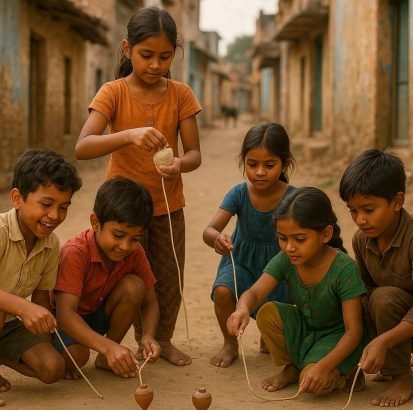
Pom Latom, Lattu, or the spinning top game is a traditional play activity found across many parts of India and Asia. Using a wooden top and a wound string, players compete in skill, balance, timing, and control as they launch, spin, lift, and sometimes battle their tops in different creative ways.
About the Game
The spinning top game is one of the most enduring traditional children’s games, played with a top usually made of wood and a string wound around it. When the string is pulled sharply, the top spins rapidly on its pointed tip and remains upright through balance and rotational motion.
The game has many local forms and names. Some players compete for the longest spin, while others use the top in target games, trick play, or top-versus-top challenges.
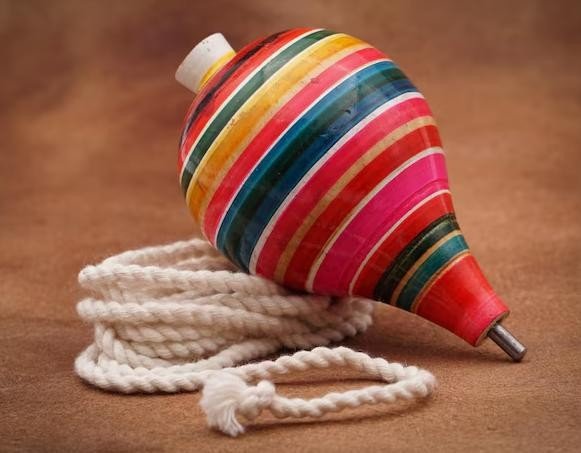
Top and Rope
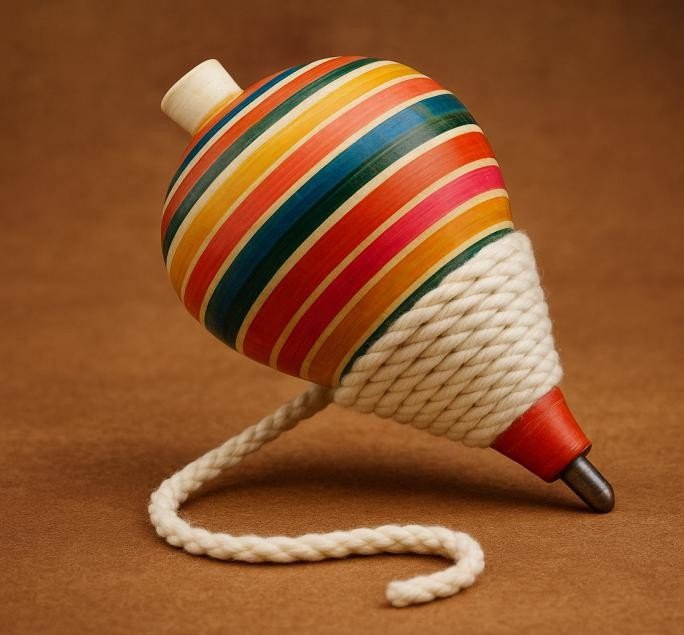
Wound String
Origin
Tops have long been part of traditional play culture in India, where they are known by names such as Pambaram in Tamil Nadu and Bhavra in several other regions. Traditionally, tops were carved from wood, sometimes with a metal tip at the bottom for durability and smoother spinning.
The game became popular because it needed only a simple handmade object and open space. Over time, children developed many local variations based on balance, endurance, trick skill, and playful competition.
The Setup
Materials Needed
Top
A wooden or plastic spinning top with a pointed bottom, sometimes tipped with metal.
String
A strong string or rope about 2 to 3 feet long for winding and launching the top.
Surface
A flat and fairly smooth ground for stable spinning.
Playing Material
The Play
Preparing the Top
- Hold the top in one hand.
- Wrap the string tightly around the top from the tip upward toward the wider part.
- Leave a small length of string loose at the end for gripping.
Spinning Method
- Hold the loose end of the string firmly.
- Grip the wrapped top in the other hand.
- Swing the arm downward and pull the string sharply.
- Release the top onto the ground so it lands upright on its tip.
Watching the Spin
If released correctly, the top spins smoothly and remains balanced on its point. Players observe whose top spins longest, most steadily, or with the best control.
Game Variations
| Variation | Description |
|---|---|
| Longest Spin | The player whose top spins the longest wins. |
| Target Circle | Players try to spin the top inside a marked circle. |
| Knock-Out Play | Players aim to knock another top out of a circle or off balance. |
| Palm Spin | Advanced players lift the spinning top onto the palm. |
| Battle of Tops | Two or more tops are launched close together in a contest of endurance and contact. |
Tips for Better Spinning
- Wrap the string tightly for stronger release.
- Release the top as upright as possible.
- Use a firm but controlled pull.
- Play on smooth, flat ground for greater stability.
Skills Developed
Physical Skills
- Improves hand-eye coordination.
- Develops wrist control and grip strength.
- Enhances timing and precision of movement.
Mental and Social Skills
- Builds patience and concentration.
- Encourages experimentation and skill improvement.
- Promotes friendly competition and shared play.
Cultural Significance
The spinning top has been a beloved part of childhood for generations, especially in rural and neighborhood settings. It reflects a traditional play culture in which simple handmade objects could create skillful, exciting, and social games.
Even with modern toys available today, the traditional wooden top continues to hold cultural charm as a symbol of craftsmanship, motion, and playful ingenuity.
Note
Pom Latom or Lattu remains a timeless traditional game that transforms balance, motion, and practice into joyful play. It is easy to learn, hard to master, and still worthy of revival in schools and community spaces.