Pallanguli
Traditional Sport of India
Pallanguli / Pallankuzhi
Pallanguli, also known as Pallankuzhi, is a traditional South Indian board game from the ancient
mancala family that revolves around counting, sowing, and strategic capture. It is usually played
on a board with 14 pits using seeds, shells, or small stones, and it is especially associated with
Tamil Nadu while also appearing in regional forms across South India and beyond.
About the Game
Pallanguli is a traditional board game in which players distribute counters through a row of pits,
capture according to fixed rules, and try to accumulate the larger share by the end of play. It is
commonly played on verandahs, courtyards, and household spaces, often using wooden boards and natural counters.
The game is valued not only as recreation but also as an exercise in mental calculation, planning,
and patient observation. Its structure reflects a long Indian tradition of learning through play.
Traditional Board
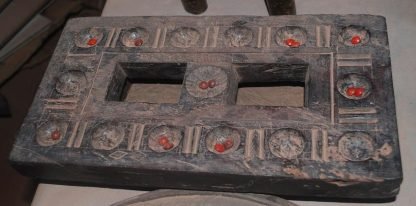
Origin
Pallanguli is deeply associated with Tamil Nadu and Kerala, though related forms are played across Karnataka,
Andhra Pradesh, Sri Lanka, and parts of Southeast Asia through older cultural links and movement of communities.
Sources describe it as an ancient South Indian mancala game, and some local claims connect pit-like game traces
to deep antiquity. Whether played on carved wooden boards, stone surfaces, or ground pits, it has long formed part
of domestic and social life.
Historical Trace

Living Tradition
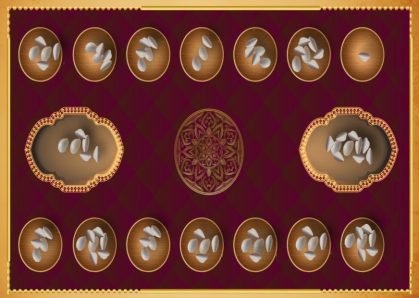
The Setup
Pallanguli boards were traditionally made of wood, though stone, brass, clay, and even floor-marked versions also exist.
The most familiar layout uses two parallel rows of seven pits each, for a total of 14 pits.
Board Design
- Two rows of 7 pits, totaling 14 pits.
- Some boards also include larger end pits or storage spaces, depending on the regional form.
- Boards may be carved and decorative, especially in household or ceremonial versions.
Counters
Players commonly use tamarind seeds, cowrie shells, beads, or small stones as counters. A common setup uses
6 counters in each pit, though some regional or older versions use different starting counts such as 5, 7, or 12.
Players
The game is usually played by two players sitting opposite each other, each controlling the seven pits on their side.
Board in Use
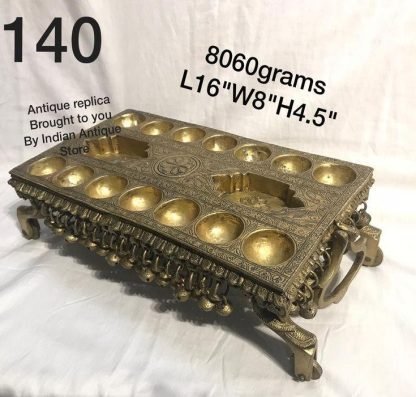
The Play
The aim of Pallanguli is to capture as many counters as possible through intelligent sowing and timely capture.
A player begins by picking all the counters from one pit on their own side and then dropping them one by one into
successive pits in order.
Starting the Game
- Each player fills the seven pits on their side with the agreed number of counters.
- The first turn is chosen by agreement or by a simple deciding method.
- The player begins from any pit on their own side.
Sowing Process
- The player picks up all counters from one chosen pit.
- The counters are distributed one by one into following pits in sequence.
- If the last counter lands in a non-empty pit in a playable version, sowing may continue from that pit depending on the regional rules.
- If it lands in a qualifying empty pit, capture may occur according to the variant.
Capturing
Capture rules vary by region, but one common form allows capture when the final counter lands in an empty pit on the
player’s own side and the opposite pit contains counters. Those opposite counters are then collected by the player.
Some traditions also identify special situations such as pits accumulating exact counts or unusable empty pits in later rounds.
This makes Pallanguli a family of related rules rather than a single identical version everywhere.
Continuation and Winning
Players continue alternating turns until one side cannot continue under the current round conditions. At that point,
captured counters are counted and a new round may begin with pits refilled from each player’s own collection.
The winner is the player who finishes with the greater number of counters after the agreed number of rounds or when the
opponent can no longer sustain play.
Winning Strategies
- Count ahead to predict where the last counter will land.
- Protect key middle pits and avoid leaving easy captures.
- Use moves that create future capture opportunities rather than only immediate gain.
- Track empty pits carefully because they reduce your options in later rounds.
Strong players rely heavily on mental counting and memory of pit states.
Common Mistakes
- Ignoring counting and relying only on guesswork.
- Leaving too many empty pits open to the opponent.
- Failing to manage refilling properly between rounds.
- Assuming an early lead guarantees the final result.
Regional Variations
| Region | Local Name | Typical Note |
|---|---|---|
| Tamil Nadu | Pallankuzhi | Strong domestic tradition, often decorative wooden boards. |
| Karnataka | Ali Guli Mane | Related South Indian mancala form with local rule differences. |
| Andhra Pradesh | Vamana Guntalu | Often played with simpler local adaptations. |
| Kerala | Kuzhipara | Another closely related pit-and-counter tradition. |
Educational Value
Pallanguli strengthens mathematical reasoning, counting accuracy, foresight, and decision-making. Because players must
plan moves and read future pit states, it is well suited to informal mathematical learning.
It also encourages patience, turn-taking, and social interaction in a calm setting.
Glossary
| Term | Meaning |
|---|---|
| Kuzhi | A pit or cup on the game board |
| Counters | Seeds, shells, stones, or beads used in play |
| Store | Place where captured counters may be kept in some variants |
| Capture | Taking counters according to the rules of the variant being used |
Notes
Pallanguli is a vivid example of India’s traditional games blending logic, patience, and pleasure.
Beyond entertainment, it preserves cultural memory and demonstrates how strategy and mathematics were
naturally woven into everyday play.