Noothan guchi / pick the stick
Traditional Sport of India
Noothan Guchi / Pick the Stick
Noothan Guchi is a traditional Indian dexterity game played with a small bunch of thin sticks. Known by different names in different regions, it is a calm but challenging game that tests concentration, patience, observation, and precise hand movement.
About the Game
Noothan Guchi, also called Pick the Stick, is a traditional game in which players try to remove one stick at a time from a scattered pile without disturbing the others.
It is simple to set up, enjoyable for different age groups, and highly effective in developing steady hands, patience, and close observation.
Game Materials
Origin and History
Noothan Guchi is a traditional Indian folk game played with thin sticks made from bamboo splinters, twigs, or small wooden pieces. For generations, children in rural homes often made the game materials themselves from natural resources.
The game is closely connected with everyday creativity in Indian folk culture, where simple natural objects became play materials. It was commonly played during quiet hours, especially indoors or in courtyards during evenings and rainy seasons.
Cultural Roots
The word “Guchi” in many Indian languages refers to a bunch or cluster of small things, which suits the nature of the game very well.
Noothan Guchi reflects a traditional style of play that values patience, attention, and skill rather than speed or expensive equipment.
The Setup
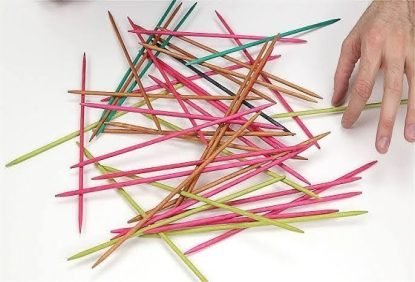
The game uses a set of around 20 to 30 small sticks. These may be homemade or store-bought, but they should be thin and light enough to scatter naturally.
- Gather a bunch of thin sticks.
- Choose a flat surface such as the floor or a low table.
- Hold the sticks together in a bunch.
- Drop them gently so that they scatter into a mixed pile.
The game can be played by 2 or more players, making it suitable for both pairs and small groups.
The Play
- The first player carefully selects one stick to remove.
- The chosen stick must be picked up without moving or disturbing any other stick in the pile.
- If the player succeeds, they keep that stick and continue picking.
- If any other stick is disturbed, the turn ends immediately.
- The next player then takes a turn.
Scoring
In the simplest version, players count how many sticks they collect by the end of the game.
In some versions, certain sticks may be marked or assigned different values based on difficulty, position, or color, making the scoring more strategic.
Winning the Game
The player with the highest total number of sticks, or the highest score in a point-based version, is declared the winner.
Variations
| Variation | Description |
|---|---|
| Basic Count Version | Players win by collecting the most sticks. |
| Point-Based Version | Different sticks carry different point values. |
| Timed Version | Players try to collect as many sticks as possible within a fixed time. |
| Team Play Version | Players work in teams and combine their scores. |
Winning Strategy
- Keep your hand steady and move slowly.
- Observe the pile carefully before choosing a stick.
- Start with sticks that appear loose or isolated.
- Avoid rushing, because patience often gives a better result than speed.
Benefits of Playing
Physical and Mental Skills
- Improves hand-eye coordination.
- Develops fine motor control in fingers and wrist.
- Enhances concentration and visual attention.
- Strengthens observation and angle judgment.
Emotional and Cognitive Benefits
- Encourages patience and self-control.
- Promotes strategic thinking and careful planning.
- Provides a calm, low-stress form of play.
- Offers simple recreation for all age groups.
Cultural Significance
Noothan Guchi reflects the resourcefulness of traditional Indian childhood, where simple natural materials became meaningful and enjoyable games.
It stands as an example of how folk play could be quiet, skillful, and deeply engaging without requiring elaborate tools or large play spaces.