Noon miani
Traditional Sport of India
Noon Miani
Noon Miani is a traditional running and chasing game from Punjab built around the idea of stealing and protecting salt or sand. It combines speed, planning, track-based movement, and teamwork, making it both exciting and strategically rich.
About the Game
Noon Miani is a traditional Punjabi outdoor game in which one player guards a central store of salt or sand while the others try to steal it and escape through marked tracks.
The game depends on timing, alertness, teamwork, and clever movement within a bounded field. Its design creates both tension and excitement as players balance risk and escape.
Traditional Field Layout
The Setup
Players
The game needs at least 5 players. One player acts as the key player or salt protector, while the others act as thieves or salt stealers.
Field Layout
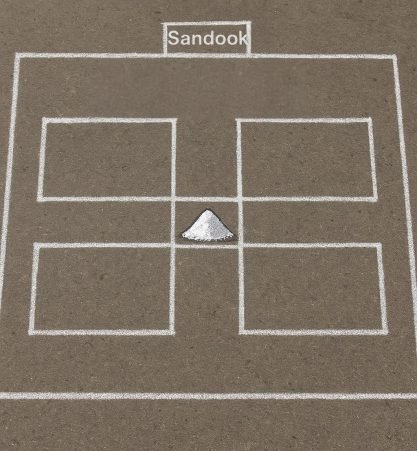
- Four equal-sized boxes are drawn on the ground in a 2×2 arrangement.
- A smaller fifth square is drawn at the center and filled with salt or sand.
- Outside the main boundary, usually toward one side, a rectangle called the sandook is marked.
- Tracks are drawn between the boxes and toward the sandook.
- Players must move only along these tracks during the game.
Roles
Key Player
Guards the salt while standing in or around the central square and moving through the tracks.
Thieves
Try to enter, grab the salt, and escape to the sandook without being tagged.
Rules
The thieves aim to steal the salt or sand from the center and carry it safely to the sandook. The key player tries to tag them before they can escape.
- The key player begins inside or near the central square, guarding the salt.
- The thieves start outside the main boundary near the tracks.
- Movement must remain within the marked track system.
The Play
- The thieves enter through the tracks and try to approach the central square.
- The key player moves through the tracks and within the boundary to stop them.
- If a thief takes the salt and reaches the sandook without being tagged, that player wins the round.
- If the key player tags a thief, that thief is out for the round.
- The round continues until all thieves have either escaped successfully or been tagged out.
- Roles may rotate after each round so different players become the key player.
Key Strategies
For the Key Player
- Stay alert and guard the central square carefully.
- Position yourself to block the most useful escape tracks.
- Watch for coordinated distraction by multiple thieves.
For the Thieves
- Use teamwork to distract the key player.
- Create false movements to open a path to the center.
- Time the escape to the sandook with speed and coordination.
Winning and Rotation
A thief wins the round by stealing the salt and reaching the sandook safely. In some versions, the successful thief becomes the next key player.
The game continues in repeated rounds so that all players get turns in different roles.
Benefits to Players
Physical and Mental Skills
- Improves agility and speed.
- Sharpens alertness and reaction time.
- Develops planning and track-based movement strategy.
Social and Cultural Benefits
- Encourages teamwork and coordination.
- Promotes healthy competition.
- Reflects the playful community spirit of Punjabi folk culture.
Cultural Significance
Noon Miani reflects the inventiveness of Punjabi traditional games, where simple materials and marked spaces are enough to create strategy, suspense, and excitement.
It remains a strong example of how folk games combine physical play, social interaction, and cultural memory in one lively activity.