Navakankari
नवकंकरी | Saalu mane Ata Jodpi Ata | Char-Par Dahdi | Nav- Kakri | Nine Men’s Morris | A strategic board game
Introduction
Navakankari is an ancient board game whose name originates from the Sanskrit words ‘Nava’- nine, and ‘Kankari’- pebbles. The name signifies the use of nine playing pieces or coins, per player. This traditional game has been played in different regions of India under various local names—Saalu Mane Ata, Jodpi Ata, or Char- Par in Kannada; Navkaankari in Gujarati; and Dahdi in Telugu. In Western countries, a similar version of this game is known as Nine Men’s Morris or Mills.
Navakankari is primarily an alignment and strategy-based game designed for two players. It combines careful planning, anticipation, and tactical movement. The game not only provides recreation but also enhances logical thinking, foresight, and strategic decision-making among players. All age groups can enjoy this game playing it indoors or in the courtyard.
Origin
Navakankari was played as early as the 4th century BCE, appearing in historical records from the Maurya and Gupta periods. Navakankari was a favorite pastime among Indian scholars, warriors and even royalty, helping players develop strategic thinking and tactical skills.
Below is an image of the Dahdi game engraved on the floor of a 400-year-old Hanuman temple village Kuluru, in Nandyal district, Andhra Pradesh.
Archaeologists have discovered boards of a version of this game carved in Egyptian temples, proving its existence over 3,000 years ago. The game was also popular in ancient Rome, where it was played on stone slabs.

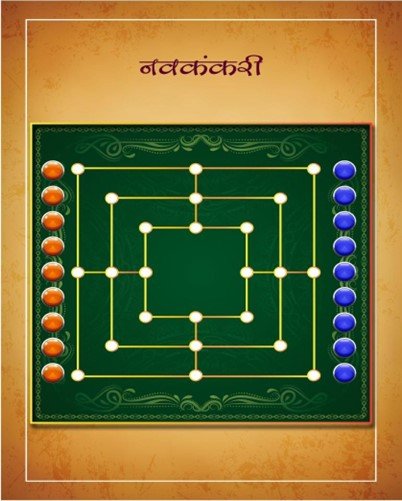
The image shows a present-day setup.
The Setup
Equipment needed
A Board: The Navakankari board consists of three nested squares connected by lines at the midpoints of each side. The intersections of these lines form twenty-four playable points.
Coins: Each player receives nine coins (traditionally small pebbles, shells, or seeds) of a distinct color or type for identification.
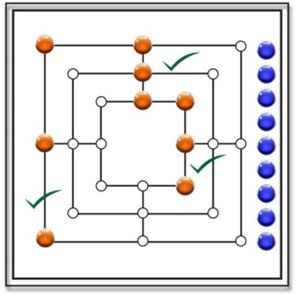
The objective of Navakankari is to align three coins (your own) in a straight line, either horizontally or vertically, forming what is called a Mill. Forming a Mill allows the player to remove one of the opponent’s coins. The game continues until one player is left with fewer than three coins or cannot make a valid move, resulting in a loss of the game.
The Play
Phases of the game
Navakankari is played in two main phases.
Phase 1 – Placing the coins
- Starting the game: Players take turns to place one coin at a time on any unoccupied intersection point on the
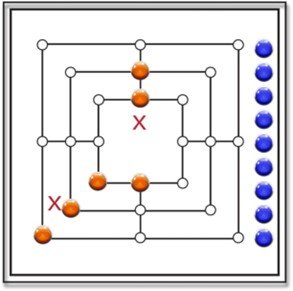
- Forming Mills: The aim during this phase is to create a Mill—three coins aligned in a straight connected line horizontally or vertically—or to block the opponent from forming one.
- Invalid Mills: A line of three coins that are not connected by a continuous line on the board does not count as a Placing 3 coins diagonally in a line is not a Mill.
- Removing opponent’s coin: Whenever a player successfully forms a Mill, they get to remove one of the opponent’s coins that is not currently part of a Coins that are part of a Mill are safe, while those outsides are vulnerable.
- Strategic removal: Players should strategically remove an opponent’s coin—especially one whose removal could help them form a Mill in the upcoming turns.
Completion of phase 1: This phase ends when all eighteen coins (nine per player) have been placed on the board.
Phase 2 – Moving the Coins
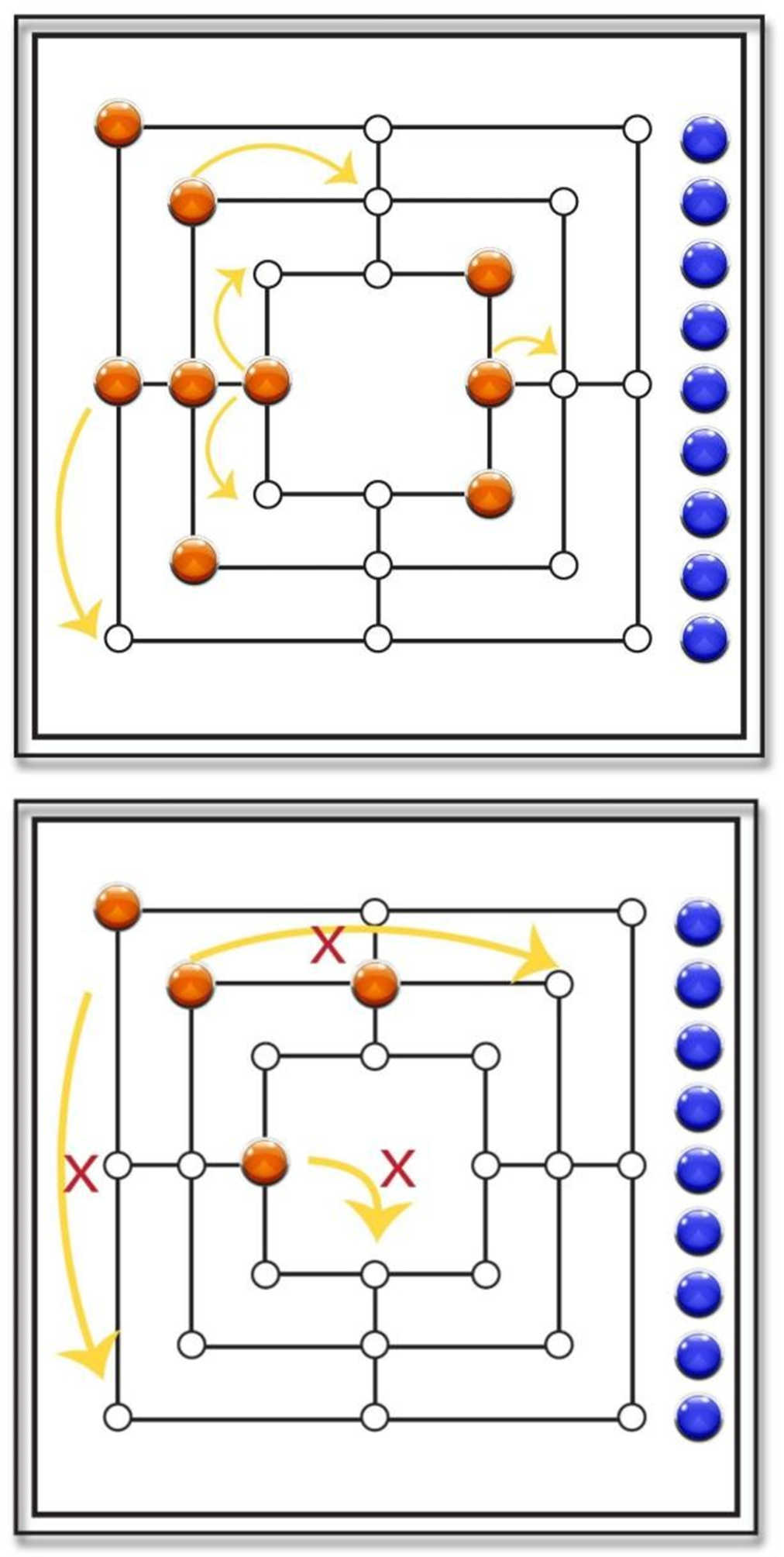
- Movement: Once all coins are placed, players begin moving their coins one at a time to an adjacent empty point connected by straight lines to form a Mill.
- Restrictions on movement: A coin cannot jump over another coin or move to a point not connected by a direct line. A coin also cannot move to a point that is already
- Forming and breaking mills: Players continue to form Mills and remove opponent coins, as in phase 1. A player may intentionally break their own Mill by moving one coin away and later remake the same Mill to remove additional opponent coins.
Limitations on repetition: The same Mill can yield up to three removals (once when first made, and twice more when broken and remade). Further repetition does not permit more removals.
Winning condition
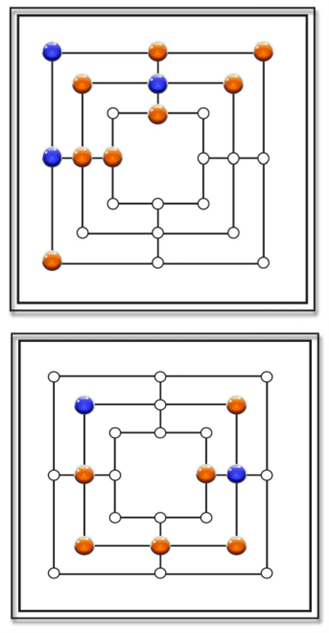
The player who is able to capture 7 of the opponent’s coins is the
winner.
A player loses when
- None of his coins can make a valid
- Only two coins of the player remain on the
Winning Strategies
- Planning: Always think two or three moves in advance to
predict your opponent’s strategy.
- Balance offense and defense: While trying to make Mills,
also block the opponent’s possible alignments.
- Use mobility wisely: Keep your coins in positions that allow flexibility for movement in later stages.
- Break and rebuild: Repeatedly breaking and reforming a Mill can be an effective tactic for eliminating multiple opponent coins.
- Observe the opponent: Pay close attention to your
opponent’s coin placements to anticipate threats early.
Common Mistakes to Avoid
- Focusing only on one area: New players often concentrate all coins in one section of the board, reducing mobility.
- Ignoring an opponent’s moves: Overlooking an
opponent’s formation can quickly turn the game.
- Blocking yourself: Poor positioning can trap your own coins and limit future moves.
- Breaking Mills too early: Breaking a Mill without a strategic purpose can waste a strong position.
Benefits of playing Navakankari
Strategic thinking: Players learn to plan, predict, and make calculated moves.
Decision-making skills: The need to choose between attack and defense enhances analytical abilities.
Concentration and patience: Sustained attention is essential for long-term planning.
Glossary
| Term | Meaning |
| Navakankari | Indian/Sanskrit word meaning Nine Pebbles. |
| Mill | A straight alignment of three coins belonging to the same player. |
| Coin/Pawn | The player’s movable piece on the board. |
| Unsafe Coin | A coin not forming part of a Mill and therefore vulnerable to removal. |
| Safe Coin | A coin that is part of a Mill and cannot be removed by the opponent. |
| Adjacent Point | A directly connected position reachable by one move. |
| Blocking | Preventing the opponent from forming a Mill. |
| Capture | The act of removing an opponent’s coin after forming a Mill. |
Navakankari is much more than a board game—it is a lesson in logic, patience, and strategy. Rooted in India’s ancient culture, it remains an engaging educational tool for developing mental agility and foresight. By learning and playing Navakankari, players experience the joy of traditional play while strengthening their cognitive and problem-solving skills.