Murgha Jhapat/Arpa Insual
Traditional Sport of India
In Arpa Sual / Murga Jhapat
In Arpa Sual, also known as Murga Jhapat, is a traditional outdoor balance game played in Uttarakhand. Inspired by the stance of roosters, it is a playful and non-violent folk sport in which players balance on one leg and try to push the opponent out of a marked circle.
About the Game
In Arpa Sual is a traditional children’s game from the hilly regions of Uttarakhand, especially known in districts such as Pithoragarh, Bageshwar, and Almora. It imitates the posture of a rooster and turns that playful idea into a test of balance, agility, and strategy.
The game is recreational, non-violent, and easy to organize. It reflects the simplicity of folk games in which skill and body control matter more than equipment.
Origins
Murga Jhapat is rooted in the rural play culture of the Himalayan foothills, where children traditionally played in village courtyards, fields, and school grounds. It is believed to have evolved as a playful imitation of cockfighting stances, but without harm or aggression.
Like many indigenous Indian games, it combines entertainment with physical development. It continues to be remembered as part of local fairs, school activities, and folk sports traditions.
The Setup
Playground
A circle is drawn on the ground using flour, chalk, limestone powder, or a stick. For two players, a circle of about 2 meters in diameter is generally suitable.
Players
The game is played between two players at a time, though teams can also participate by taking turns. It is generally suitable for children aged 6 years and above.
Traditional Play Form
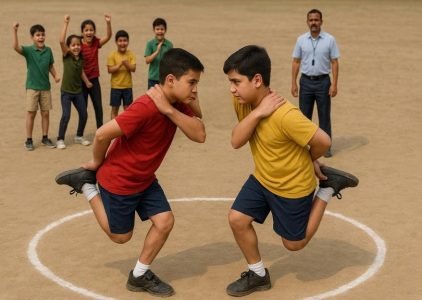
The Play
Preparation and Position
- Both players enter the circle.
- Each player folds the right leg backward at the knee and holds the right ankle with the right hand.
- The left hand is placed on the right shoulder, or in some versions used to secure the posture from behind.
- Each player balances only on the left leg.
Starting the Game
- Once both players are balanced and ready, a referee or neutral player gives the signal.
- The players begin trying to push each other using the shoulder or folded arm.
- Hands cannot be used for pushing or for extra support.
Winning Conditions
A player wins the round if they:
- Push the opponent out of the circle.
- Cause the opponent to lose balance and fall.
- Force the opponent to break the original one-leg posture.
Fouls
A player may be declared out or disqualified if:
- They touch the ground with both legs.
- They use their hands to push or support themselves.
- They step outside the circle during play.
- They release the ankle hold or change the required body position.
Scoring System
A player scores one point by successfully pushing the opponent out or making the opponent lose balance.
In team play, each team may have several players facing matching opponents in turns. The team with the higher number of points after all rounds wins.
Benefits of Playing
Physical Benefits
- Improves balance and coordination.
- Strengthens leg muscles, arms, and core.
- Develops agility and postural control.
Mental and Social Benefits
- Builds focus and self-confidence.
- Encourages sportsmanship and healthy competition.
- Provides joyful recreation with minimal resources.
Cultural Significance
In Arpa Sual represents the creativity of rural Uttarakhand, where games were shaped by body movement, imagination, and local community life rather than by formal equipment.
It helps preserve the heritage of folk physical education and reminds children that traditional games can promote health, fun, discipline, and cultural belonging at the same time.