Mukna Kangjei
ꯃꯨꯛꯅꯥ ꯀꯥꯡꯖꯩ Khung Kangjei Manipur Hockey
Mukna Kangjei is an ancient Manipuri game that beautifully combines strength, skill, and tradition. It stands as a living heritage of India’s indigenous sports.
By blending wrestling and hockey-like techniques, it provides physical fitness, mental alertness, and community spirit.
This unique combination makes Mukna Kangjei both a combat sport and a ball game, testing the player’s power, speed, and coordination. Played mostly during community festivals, it has long been a source of pride and joy for the Manipuri people, and also known as Khung Kangjei.
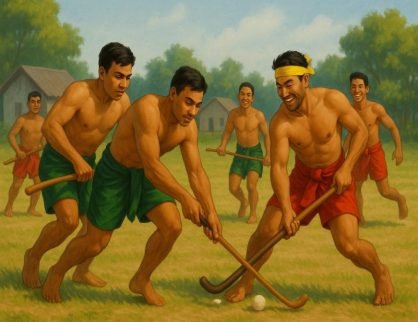
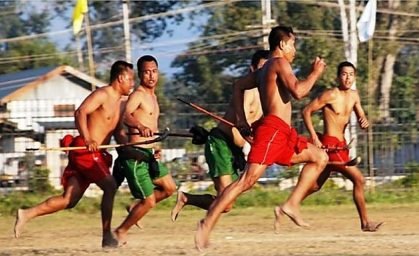
The game is played between two teams of seven players each. In the game, players hit the ball with their sticks and wrestle with each other to win the ball. They prevent each other from striking the ball by holding the opponents back or pushing them down to the ground just like in wrestling. There is no goalpost, but a goal is scored when the ball crosses the goal line.
Origin
The origins of Mukna Kangjei can be traced back to ancient Manipur, where both wrestling and stick games were popular among warriors. Historical accounts and local folklore suggest that this game was encouraged by the Manipuri kings as part of military and physical training for young men.
During the reign of King Khagemba (1597–1652 CE), Mukna Kangjei gained royal recognition and was included in festivals and ceremonial gatherings. The game was not only entertainment but also a way to demonstrate bravery, endurance, and discipline.
Even today, the sport continues to be played during Lai Haraoba, the festival that celebrates the gods and goddesses of Manipur, keeping alive the ancient traditions of the Meitei culture. The
game has two categories (1) Takhatnabi (League), (2) Naitom (Knockout).
The Setup
The Field
The game is played on an open rectangular ground, usually around 100-120 feet long and 80 feet wide.
The two ends of the field are marked with goalposts, similar to those used in hockey.
.
The Stick (Kangjei)
Made of bamboo or hardwood, with a curved end used for striking and controlling the ball.
Each player carries one Kangjei stick.
The Ball (Kangdrum)
Traditionally made from root wood or tightly woven bamboo, small and durable enough to withstand impact.
Player’s Attire
Players wear a loincloth (Langot) and a waistband, allowing free movement. Some may also wear light protective gear such as headbands or wraps.
Teams
Each side usually has seven players. One player acts as a leader
who coordinates the team’s attack and defense.
The Play
Beginning of the Game
The game starts with the ball placed at the center of the field. At the referee’s signal, players from both sides rush forward to capture it.
Movement and Control
The ball can be struck, lifted, or carried using the Kangjei stick. Players run, dodge, and wrestle to maintain possession.
Use of Wrestling Techniques
When two players struggle for the ball, they may use Mukna-style grappling. The aim is to overpower the opponent without using dangerous or violent force.
Passing and Team Play
Players can pass the ball to teammates using skillful strokes of the stick while avoiding tackles from the opposing side.
Goal Scoring
A goal is scored when a player successfully drives the ball into the
opponent’s goal area.
Duration and Decision
The match is divided into two halves. The team with the highest number of goals at the end of play is declared the winner.
Rules and Conduct
1.Players must respect the referee’s signals.
2.Striking or injuring opponents with the stick is forbidden.
3.Wrestling is permitted only when two players contest for the ball.
4.Pulling hair, clothes, or using elbows is considered a foul.
5.Fair play, teamwork, and discipline are core values of the game.
Cultural Importance
Mukna Kangjei is more than a sport—it is a symbol of Manipuri identity. It teaches the youth values such as courage, respect, and unity. The game is often performed during traditional celebrations, strengthening community bonds and reminding people of their ancestral heritage.
Through Mukna Kangjei, the people of Manipur continue to honor their warrior spirit and cultural pride.
Benefits of Playing Mukna Kangjei
Physical Development – Enhances strength, stamina, and flexibility.
Agility and Coordination – Improves body balance, reflexes, and precision.
Mental Discipline – Builds focus, patience, and sportsmanship.
Cultural Awareness – Connects the younger generation with traditional practices.
Community Unity – Encourages cooperation and teamwork among participants.
Glossary
.
Terms
Meaning
Mukna
Traditional Manipuri wrestling form
Kangjei
Curved bamboo stick used in the game
Kangdrum
The wooden or bamboo ball used for play
Lai Haraoba
A cultural festival of Manipur where traditional games are performed
Langot
Cloth worn around the waist by players
Khong Kangjei
Another traditional Manipuri ball-and-stick game
Khagemba
A Manipuri king who encouraged the sport