Mukna kangjei
Traditional Sport of India
Mukna Kangjei
Mukna Kangjei is an ancient traditional sport of Manipur that combines the power of wrestling with the speed and stick skill of a hockey-like game. Also known as Khung Kangjei, it is a striking example of India’s indigenous sports heritage and community-centered martial culture.
About the Game
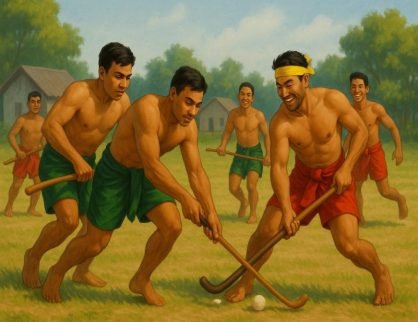
Mukna Kangjei is a traditional Manipuri sport that blends wrestling techniques with a ball-and-stick game. It tests strength, speed, balance, coordination, courage, and teamwork in a single format.
Played especially during festivals and community gatherings, the game remains a proud expression of Manipuri identity and living sports heritage.
Traditional Play
Origin
The origins of Mukna Kangjei go back to ancient Manipur, where wrestling and stick games were both valued as part of warrior culture and physical training. Traditional accounts connect the game with royal encouragement and its use in building bravery, endurance, discipline, and martial readiness.
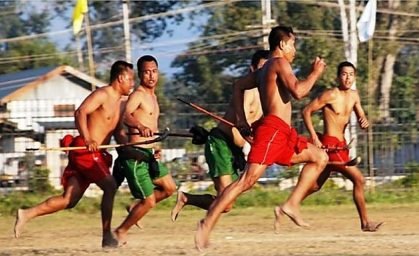
During the reign of King Khagemba, the sport gained greater recognition and was associated with festivals and ceremonial occasions. It continues to be played during Lai Haraoba, keeping alive the customs and physical culture of the Meitei people.
The game is also played in competitive categories such as league and knockout formats.
Festival and Match Tradition
The Setup
The Field
Mukna Kangjei is played on an open rectangular ground. The two ends of the field are marked as scoring ends, similar in purpose to goal areas in other field games.
Equipment and Teams
Kangjei
A bamboo or hardwood stick with a curved end used to strike and control the ball.
Kangdrum
A small durable ball, traditionally made from root wood or woven bamboo.
Attire
Players traditionally wear a langot or waist cloth that allows free movement.
Teams
Two teams of seven players each, often with one player guiding team coordination.
The Play
Beginning of the Game
The game begins with the ball placed at the center of the field. At the referee’s signal, players from both teams rush forward to gain possession.
Movement and Control
Players strike, guide, or carry the ball using the Kangjei stick while running, dodging, and protecting possession. The game demands quick movement and awareness of both ball position and opponent pressure.
Use of Wrestling Techniques
When players contest the ball, controlled grappling in the style of Mukna may be used. The aim is to overpower the opponent fairly without dangerous force.
Passing and Team Play
Teammates pass the ball using coordinated strokes of the stick while trying to avoid tackles and blocks. Team support and timing are essential to create scoring chances.
Goal Scoring
A score is made when the ball is successfully driven into or across the opponent’s scoring area.
Duration and Decision
The match is usually divided into two halves, and the team with the higher number of goals at the end is declared the winner.
Rules and Conduct
- Players must follow the referee’s signals and decisions.
- Hitting or injuring an opponent with the stick is not allowed.
- Wrestling is permitted only during a genuine contest for the ball.
- Pulling hair, grabbing clothes, or using elbows is considered a foul.
- Fair play, teamwork, and self-discipline are essential values of the sport.
Cultural Importance
Mukna Kangjei is more than a competitive game. It is a cultural symbol of Manipuri strength, unity, courage, and ancestral pride.
It is often presented during traditional celebrations and helps connect younger generations with the warrior spirit and collective memory of the community.
Benefits of Playing Mukna Kangjei
Physical Benefits
- Enhances strength, stamina, and flexibility.
- Improves agility, reflexes, and body coordination.
- Develops balance, speed, and stick control.
Mental and Social Benefits
- Builds focus, patience, and sportsmanship.
- Encourages teamwork and cooperation.
- Strengthens cultural awareness and community belonging.
Glossary
| Term | Meaning |
|---|---|
| Mukna | Traditional Manipuri wrestling form |
| Kangjei | Curved bamboo or wooden stick used in the game |
| Kangdrum | The ball used for play |
| Lai Haraoba | A cultural festival of Manipur where traditional games are performed |
| Langot | Traditional cloth worn around the waist by players |
| Khong Kangjei | Another traditional Manipuri ball-and-stick game |
| Khagemba | A Manipuri king associated with the encouragement of the sport |