Moksh Patam
Traditional Sport of India
Parampadam / Moksha Patam / Gyan Chaupar
Parampadam, also known as Moksha Patam, Vaikunthapali, Gyan Chaupar, and later Snakes and Ladders, is an ancient Indian board game that teaches moral and spiritual ideas through play. In the traditional form, ladders represent virtues that raise the soul, while snakes represent vices that pull it downward on the journey toward moksha, or liberation.
About the Game
Parampadam is the original Indian form of the modern game now widely known as Snakes and Ladders. Traditional boards presented life as a moral journey, where progress and downfall reflected karma, discipline, and inner qualities.
The final square symbolizes moksha, meaning liberation from the cycle of birth and death. Older boards could be more complex than modern 100-square sets and often included named squares linked to virtues, vices, and theological ideas.
Origin
Gyan Chaupar or Moksha Patam was played in medieval India and Nepal, where it functioned not only as entertainment but also as a teaching tool about moral conduct and spiritual ascent. Traditional boards explicitly mapped ideas such as virtue, vice, karma, and liberation.
The game later traveled to Britain, where it was transformed into the modern race game Snakes and Ladders. Around 1832, Captain Henry Dundas Robertson presented a version called the “Shastree’s Game of Heaven and Hell” to the Royal Asiatic Society, showing an early stage in this transmission.
Key Terms
- Moksha: Liberation or spiritual release, symbolized by the final square.
- Dharma: Right conduct or duty; adharma is its opposite.
- Guna: Virtue; dosa or papa: vice or fault.
- Karma-phala: Action and consequence, reflected in rises and falls.
- Samsara: The cycle of worldly existence.
- Sopana: Ladder; sarpa: snake; pasha: die.
Traditional Board
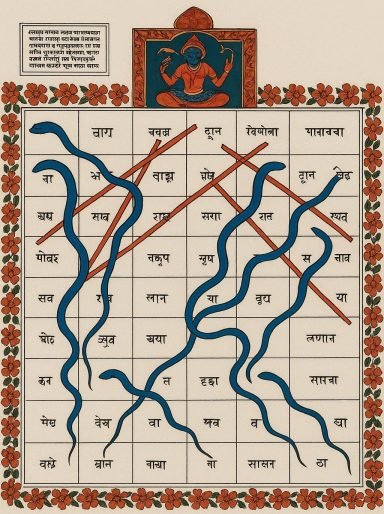
Board Variant
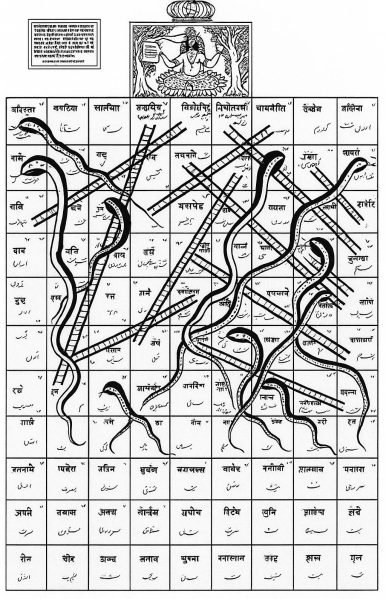
Another Traditional Form
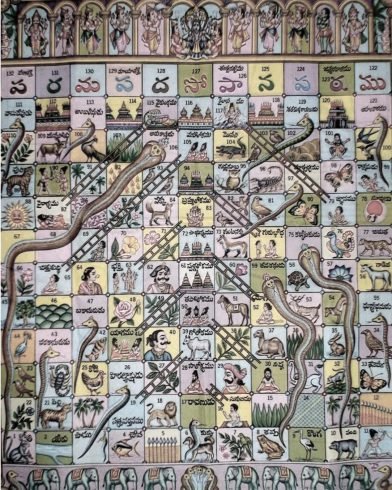
The Setup
Board Design
- Traditional versions could use larger boards, including variants such as 72, 84, 100, or even 132 squares.
- The common modern form is a 10×10 board numbered from 1 to 100.
- Ladders connect lower squares to higher ones, while snakes connect higher squares to lower ones.
- Many heritage boards label squares with virtues, vices, or cosmological concepts.
Materials Required
- One game board, either moral-labeled or standard numeric.
- One six-sided die.
- Two to four player tokens, though some regional sets allow more.
The Play
- Players take turns rolling the die to enter and move across the board.
- Movement is forward according to the number rolled.
- Landing at the bottom of a ladder raises the player immediately to a higher square.
- Landing on the head of a snake sends the player down to its tail.
- Many versions give an extra roll for a six.
- In many rule sets, players must roll the exact number needed to reach the final square.
Winning Condition
The first player to reach the final square with the required exact roll wins. In the traditional interpretation, this is not just a race victory but a symbolic attainment of moksha.
Moral Pedagogy
Traditional boards used ladders to represent virtues such as generosity, humility, truth, faith, and knowledge, while snakes represented greed, pride, anger, violence, delusion, and other faults. This structure turned the game into a lesson in karma and character.
Many older boards had more snakes than ladders, emphasizing that the path to liberation is difficult and requires vigilance. The game taught that setbacks and rises are linked to conduct, not only luck.
Traditional and Modern Editions
Traditional Forms
- Explicit moral labels on squares.
- Theological and cosmological symbolism.
- Greater emphasis on ethical learning.
- Regional variations such as Gyan Chaupar, Moksha Patam, and Parampadam.
Modern Snakes and Ladders
- Usually simplified into a race game.
- Moral labels often removed.
- Focus shifts more toward chance and quick play.
Example Moves
A player landing at the base of a ladder immediately rises to its top, symbolizing uplift through virtue. A player landing on a snake’s head falls to a lower square, reflecting regression caused by vice or lack of awareness.
Near the end of the board, the exact-roll rule adds tension and reinforces the idea that liberation requires precision, patience, and disciplined progress rather than careless advance.
Board Variants
| Variant | Typical Form | Main Character |
|---|---|---|
| 72-Square Gyan Chaupar | Cloth or paper board with dense symbolic mapping | High philosophical density |
| 84-Square Jain Variant | Regional form with Jain cosmological ideas | Strong moral and spiritual emphasis |
| 100-Square Moksha Patam | Most familiar form and basis for modern editions | Simplified virtues and vices leading to final liberation |
Educational Value
Parampadam is an important example of how play was used in India to teach ethics, self-reflection, and philosophical ideas. It encourages discussion of duty, conduct, consequence, and the difficulty of inner discipline in everyday life.
Even today, it can be used in classrooms to introduce children to Indian thought through a familiar game structure.
Notes
Parampadam embodies a distinctly Indian idea of learning through symbolic play. By turning ladders and snakes into moral metaphors, it transforms a simple board game into a reflection on samsara, karma, and the aspiration for moksha.