Mallakhamb
Traditional Sport of India
Mallakhamb
Mallakhamb is one of India’s most distinctive traditional physical disciplines, combining strength, balance, flexibility, yoga-like postures, and acrobatic movement on a pole or rope. Originally used to train wrestlers, it later evolved into a respected competitive sport and a major symbol of India’s physical culture heritage.
About the Sport
Mallakhamb is a traditional Indian sport performed on a wooden pole, hanging rope, or suspended apparatus. It blends the discipline of yoga, the athleticism of gymnastics, and the control of acrobatics into one powerful training system.
The name comes from two Sanskrit words: Malla, meaning wrestler, and Khamba, meaning pole or pillar. This reflects its early use in wrestler training and physical conditioning.
Origin
Mallakhamb has deep roots in Indian physical culture and is believed to have evolved from older practices of body training and climbing exercises. Its organized modern form is strongly associated with Balambhatta Dada Deodhar, who developed and refined it in the 19th century in Pune.
He is traditionally credited with using pole-based exercises to improve the strength, agility, and courage of wrestlers. Over time, the practice spread through akharas, schools, and physical education traditions across India.
The Setup
Mallakhamb is practiced using different kinds of apparatus, each requiring its own technique, grip, and body control.
Pole Mallakhamb
A smooth wooden pole on which the performer climbs, balances, spins, and holds postures.
Rope Mallakhamb
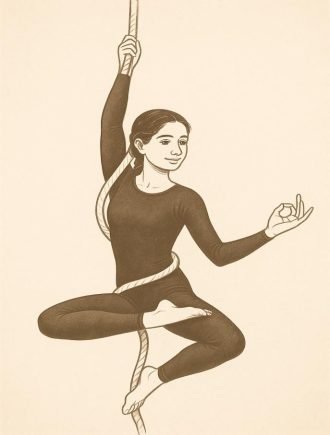
A suspended cotton rope used for wrapping, balancing, and aerial postures through grip and friction.
Hanging Mallakhamb
A suspended wooden pole that moves while the performer executes controlled positions and transitions.
Mallakhamb Apparatus
Rules
In demonstrations and competitions, Mallakhamb follows structured performance rules rather than combat rules. Athletes are judged on technical quality, control, and execution.
- Duration: Each participant usually performs for about one to one and a half minutes.
- Scoring: Judges assess difficulty, precision, body alignment, flow, and confidence.
- Surface: Safety mats are placed around the apparatus.
- Attire: Tight and minimal clothing is worn to help maintain grip and freedom of movement.
The Play
Order of Performance
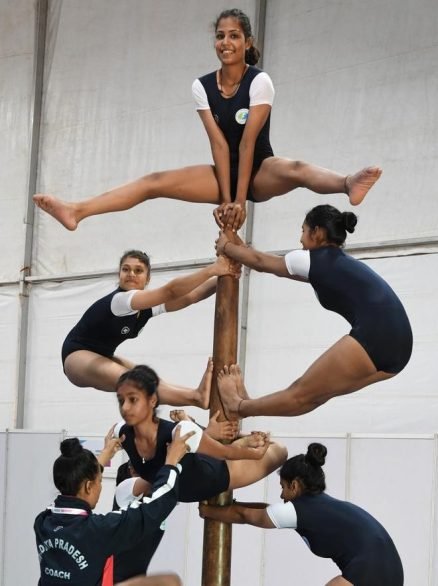
Participants perform one by one according to a decided sequence or draw in individual and team events. Mallakhamb is now presented in organized championships at school, state, national, and broader competitive levels.
Techniques and Movements
Learning begins with simple climbing, gripping, and holding positions, then moves gradually toward more demanding balances, inverted poses, spins, and flowing transitions.
Competition Performance
Basic Skills Needed
- Climbing with coordinated use of hands, legs, thighs, and breath control.
- Developing secure grip and locking positions for stability.
- Holding yoga-inspired postures with control and balance.
Many postures are inspired by yogic forms, making Mallakhamb a discipline that unites athletic training with body awareness and composure.
Advanced Skills
Once strength and control are established, learners progress to inverted balances, spins, dynamic entries, and controlled descents.
- Brahmachari position.
- Chakra spin.
- Reverse descent.
- Complex rope wraps and suspended balances.
Safety and Caution
Because Mallakhamb involves height, inversion, and friction-based movement, safety is essential in training.
- Warm-up and stretching must be done before practice.
- Beginners should always train under a qualified instructor.
- The apparatus should be properly maintained and checked regularly.
- Safety mats must be placed around the practice area.
- Practice should be avoided when the student is tired, dizzy, or unfocused.
- Hydration and recovery are important parts of responsible training.
Health and Educational Value
Mallakhamb provides a complete physical and mental workout. It develops the body through disciplined movement while also sharpening attention and confidence.
Physical Benefits
- Builds core strength and flexibility.
- Improves posture, coordination, and reflexes.
- Enhances grip power and muscular endurance.
Mental Benefits
- Teaches discipline, patience, and concentration.
- Boosts confidence and body awareness.
- Encourages fearless but mindful movement.
Cultural Significance
Mallakhamb is a strong expression of India’s traditional physical culture and the idea that strength and spirituality can exist together. It shows how movement can be both powerful and meditative.
The sport continues to gain recognition through demonstrations, championships, and educational programs. It is valued not only as exercise, but also as a living connection to India’s heritage of disciplined fitness.
Note
Mallakhamb represents balance, courage, control, and grace. By preserving and practicing it, India continues a tradition in which the body, mind, and spirit are trained together through artful movement.