Lathi chhora
Traditional Sport of India
Lathi Chor / Aambali Peepli
Lathi Chor is a traditional outdoor game associated with Bengal, while in Gujarat a similar form is known as Aambali Peepli. The game combines tree climbing, speed, teamwork, distraction, and tagging, making it an energetic and strategic form of traditional play.
About the Game
Lathi Chor is a traditional children’s game built around a tree, a stick, and a group of players who take on the roles of guard and thieves. It combines physical agility with planning and group coordination.
The game reflects a long-standing Indian tradition of outdoor tree-based play, especially during vacations and free time in village or neighborhood spaces.
Origin
Tree-climbing games have been a favorite part of childhood in many parts of India, and Lathi Chor is one such example from Bengal. In Gujarat, a similar style of play is known as Aambali Peepli, named after two kinds of trees.
The game shows how local environments, especially climbable trees and open ground, naturally shaped traditional play.
The Setup
Usually five or six players gather near a safe tree. A small circle is drawn on the ground to place the stick.
- Choose a safe and climbable tree.
- Select one player to be the lathi fetcher or guard.
- Draw a circle of about 2 feet in diameter for the stick.
- Mark a starting line or boundary for the thieves.
Roles
Lathi Fetcher
The single guard protects the tree area and tries to tag the thieves.
Chors
The other players act as thieves and try to approach, climb, or reach the stick without being tagged.
Traditional Play Scene
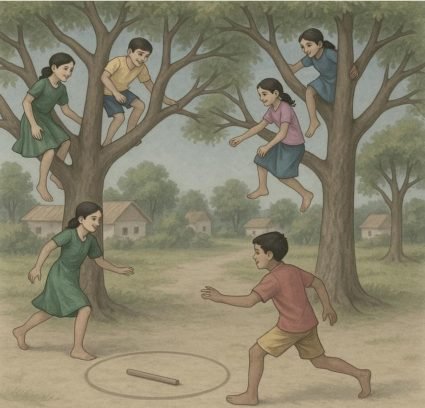
The Play
One player throws the stick away with force, often from under the leg, and the chosen fetcher runs to retrieve it. While the fetcher is away, the other players rush to climb the tree and prepare for the next stage of play.
When the fetcher returns and places the stick back in the circle, the thieves try to come down, approach the circle, and take the stick without being caught.
Starting the Game
The thieves begin from a designated distance away from the tree. The fetcher stays near the tree and circle, trying to defend the area and stop the thieves from succeeding.
Chor Strategy
The thieves must work together to distract, confuse, or outmaneuver the fetcher. Their goal is to get close enough to the circle or tree while staying untagged.
Lathi Fetcher’s Role
The fetcher guards the stick and the tree, using speed and awareness to tag approaching thieves. Because only one player defends the area, the fetcher must react quickly and choose the biggest threat first.
Tagging and Safety Zone
- A thief is considered out if tagged before safely climbing the tree or completing the required action near the circle.
- Once a thief has climbed the tree fully, that player is safe and cannot be tagged.
- The player caught near the stick or circle may become the fetcher in the next round.
Winning Conditions
For the Thieves
- Most or all thieves safely reach the tree or complete the action without being tagged.
For the Fetcher
- The fetcher tags most or all of the thieves before they can succeed.
Key Strategies
For the Thieves
- Use teamwork to distract the fetcher.
- Make fake runs or sudden movements.
- Time approaches carefully instead of rushing together without planning.
For the Fetcher
- Guard the tree and circle strategically.
- Watch for the nearest and fastest-moving threat.
- Anticipate group tricks and deceptive movement.
Safety Tips
- Use a soft or symbolic stick to avoid injury.
- Choose a tree with strong and safe branches.
- Make sure the ground is clear of dangerous objects.
- Supervise younger children during climbing.
Skills Developed
- Agility and climbing ability.
- Speed and reaction time.
- Team coordination and deception.
- Strategic movement and risk judgment.
- Confidence in outdoor physical play.
Cultural Value
Lathi Chor and Aambali Peepli show how traditional Indian games turned natural spaces such as trees into exciting play environments. They reflect a childhood culture of movement, courage, and shared outdoor adventure.