Kuttu Varisai
Traditional Games of India
Kuttu Varisai
Kuttu Varisai is a traditional martial art of Tamil Nadu known for unarmed combat,
body control, disciplined movement, and inner balance. Often described as the unarmed
component of Silambam, it combines striking, grappling, footwork, breathing, and restraint.
Region
Tamil Nadu
Type
Traditional unarmed martial art
Main Focus
Agility, self-control, balance, and self-defense
About the Art
Kuttu Varisai is a South Indian martial discipline centered on unarmed combat and controlled body movement.
The name is commonly understood as a sequence of combat movements or striking patterns.
More than a fighting system, it is also a tradition of discipline, restraint, and inner strength.
It teaches students how to coordinate breath, posture, footwork, and reaction under pressure.
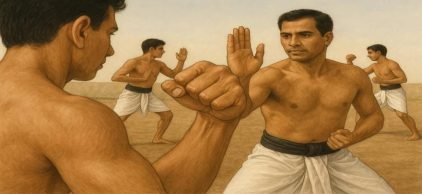
Martial Tradition
Origin
Kuttu Varisai is regarded as one of the old martial traditions of South India and is linked
with ancient Tamil warrior culture. Literary references to combat training, heroic discipline,
and martial values appear in early Tamil works such as Silappadikaram and Purananuru.
It is understood as part of a larger Dravidian martial training system that included both armed
and unarmed methods. Traditional schools prepared youth in weapon skills as well as empty-hand
combat, endurance, and discipline.
Beyond royal and warrior circles, Kuttu Varisai was also practiced in villages for self-defense,
physical fitness, and community strength.
Combat Stance
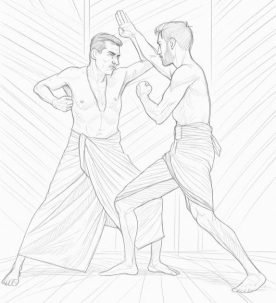
The Setup
Training Structure
Kuttu Varisai training brings together yogic control, martial rhythm, and tactical movement.
It can be practiced alone, in pairs, or in supervised group sessions.
Physical Conditioning
Stretching, squats, balance work, and breathing control.
Adi Varisai
Footwork patterns and circular movement for balance and evasion.
Kai Varisai
Hand techniques such as punches, open-palm strikes, and blocks.
Kaal Varisai
Kicking methods for low, middle, and high attack or control.
Locks and Throws
Wrist locks, body twists, sweeps, and unbalancing techniques.
Meditation
Breathing and concentration exercises for calm and control.
Students progress through varisai, or structured sequences, which improve timing,
rhythm, precision, and self-mastery.
Core Principles
- Agility is valued more than aggression.
- Breath and movement must work together.
- Respect and restraint guide all training.
- The body itself becomes the primary instrument of defense.
- The practice is connected with traditions of mental and sensory control.
The aim is not uncontrolled combat, but alertness, body coordination, and disciplined physical training.
The Ground
Training is best done on a flat open area, preferably on sand or soft soil.
A circular or rectangular practice space may be marked, and the surface should be clean and free from hazards.
No special equipment is required for basic unarmed training. Participants usually train barefoot or in light footwear.
Player Grouping
For pair work, students are usually matched by similar height and weight.
Group activities may be organized into teams of four to six members under teacher supervision.
Basic Rules
- Players stand facing each other, or in some versions back-to-back at the start.
- On the teacher’s signal, players try to push, pull, or unbalance the partner without striking.
- The aim is to force the opponent to lose balance or step outside the marked area.
- Leverage, timing, footwork, and momentum are used instead of hitting.
- After each round, winners are announced and pairs may be rotated.
Training Steps
Step 1: Warm-Up
Begin with light jogging, stretching, breathing, and basic balance drills.
Step 2: Demonstration
The instructor demonstrates safe posture, correct balance, and proper pushing or pulling methods.
Step 3: Practice Rounds
Children practice in pairs, alternating attack and defense with controlled movement.
Step 4: Mini-Competition
Short supervised bouts may be held, often around one minute each, with points awarded to winners.
Step 5: Cool Down
Sessions end with deep breathing and stretching to relax the body.
Precautions
- Always practice on soft ground.
- No hitting, kicking, or rough force is allowed in basic educational play.
- Stop immediately if anyone falls badly or feels pain.
- Teacher supervision is essential throughout the activity.
Relation to Silambam
Kuttu Varisai is often described as the unarmed branch of Silambam, the famous martial art of Tamil Nadu.
Traditionally, students first learned body control, stance, and footwork through unarmed practice before
moving on to weapons such as the staff, spear, or sickle.
Cultural Significance
In Tamil society, martial arts were understood not only as combat training but also as a path of self-cultivation.
Kuttu Varisai helped instill discipline, humility, courage, endurance, and respect for teachers.
During local gatherings and temple festivals, demonstrations of Kuttu Varisai highlighted grace, balance,
rhythm, and controlled strength. The art expressed the idea that true power lies in mastery, not aggression.
Decline and Revival
Like many traditional martial systems, Kuttu Varisai declined during colonial rule, when indigenous fighting arts
were often restricted. Even so, the practice survived through folk traditions, temple guardians, and local teachers.
In recent times, revival efforts and modern training approaches have helped preserve the spirit of the art for younger generations.
Educational Value
Physical Development
- Builds stamina, flexibility, and balance.
- Improves reflexes and movement control.
- Strengthens posture and coordination.
Mental and Ethical Growth
- Improves focus, discipline, and confidence.
- Promotes non-violence and cooperation.
- Connects learners to Tamil cultural heritage.
Note
Kuttu Varisai represents the ancient Tamil spirit of discipline, valor, and grace.
Once practiced by warriors and villagers alike, it remains a living symbol of Dravidian martial heritage.
Its enduring message is simple: master the body, calm the mind, and strength will remain under control.