Kukur Mekuri
Traditional Sport of India
Kukur Mekori
Kukur Mekori is a traditional children’s game from Assam that combines role-play, movement, teamwork, and playful imagination. Rooted in Assamese village life, it reflects the closeness of children to animals, family roles, and everyday rural scenes.
About the Game
Kukur Mekori is a traditional Assamese children’s game played in open courtyards or fields, usually during leisure time or in the evening. It combines imagination, physical play, dramatic dialogue, and group coordination.
The game recreates familiar village scenes involving humans, animals, and elders, making it both entertaining and socially meaningful.
Origin
Kukur Mekori has long been part of Assamese rural childhood and has traditionally been passed from one generation of children to the next through oral teaching and imitation.
Like many folk games, it developed in communities where children used imagination and teamwork instead of toys or equipment. Its characters such as Manuh, Kukur, Mekuri, and Burhi give it a playful dramatic structure.
The Setup
Number of Players
The game is usually played by 6 to 12 children, though there is no strict limit. It is generally suitable for mixed age groups from about 6 to 12 years.
Roles
Two Leaders
These players act as the humans or Manuh.
One Burhi
One child takes the role of the old lady.
Kukur
Some children play the role of dogs.
Mekuri
Some children play the role of cats.
Traditional Play Scene
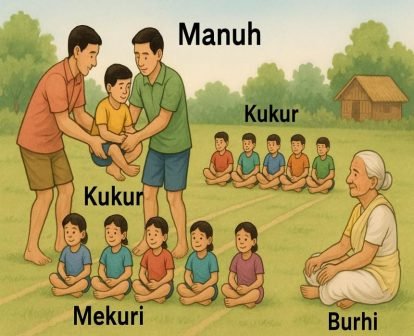
The Ground
The game is usually played in a courtyard, school ground, or any open space of about 15 to 20 feet. A clear and safe surface is important for comfortable sitting, lifting, and chasing.
The Layout
- Children sit in a semi-circle in Padmasana, holding their toes.
- The two leaders stand in the center area.
- Different role zones are imagined at varying distances from the main sitting place.
- Mekuri are placed farthest away, about 7 to 8 steps.
- Kukur are placed around 4 to 5 steps away.
- Burhi is placed nearest, about 1 to 2 steps away.
Materials Required
No equipment is required. This simplicity makes the game easy to organize in almost any open space.
The Play
Step 1 – Seating and Carrying
All children sit cross-legged in a semi-circle while the two leaders lift each child one by one by the arms. According to the child’s weight, the leaders place them into the role zones of cat, dog, or old lady.
- Lightweight children become Mekuri and are placed farthest away.
- Medium-weight children become Kukur and are placed at middle distance.
- The heaviest child becomes Burhi and is placed closest to the original place.
Step 2 – Role Play and Dialogue
Once everyone is placed, a playful conversation begins between the leaders and the Burhi. This spoken exchange adds drama, humor, and cultural flavor to the game.
Step 3 – Action and Chase
- The leaders move toward the dog zone after speaking to the Burhi.
- The dogs begin shouting and chasing the leaders.
- The leaders run back toward the Burhi.
- This creates a lively and joyful chase scene.
Rules
- No child should leave their assigned position unless it is part of the turn or role action.
- The leaders must carry each child gently and carefully.
- Pushing, pulling, or rough physical play is not allowed.
- The dialogue and chase should remain friendly and playful.
Scoring and Rounds
Kukur Mekori is not usually played as a point-based competition. Its main purpose is participation, role-play, laughter, and coordination.
If desired, players may give informal appreciation for best acting, funniest dialogue, or smoothest carrying, but the game is mainly non-competitive.
Cautions
- Make sure the ground is soft and free from stones, sharp objects, or uneven patches.
- Younger children should always be lifted gently.
- Avoid crowded or unsafe areas.
Benefits to the Players
Physical and Mental Benefits
- Improves flexibility through cross-legged sitting posture.
- Builds strength for the leaders who lift and place players.
- Develops awareness of balance and body weight.
- Strengthens attention and coordination during movement and chase.
Social and Emotional Benefits
- Encourages teamwork and empathy.
- Promotes care and gentleness among players.
- Builds creativity through role-play.
- Creates emotional connection through shared laughter and participation.
Cultural Significance
Kukur Mekori reflects Assamese rural life, where children learn through shared play, imitation, and storytelling. It shows how traditional games can teach social roles, kindness, cooperation, and imagination without any material resources.
The game also highlights the coexistence of strength and gentleness, a value seen in the way leaders carry younger children with care while still guiding the action of the game.
Notes
Kukur Mekori is a vibrant part of Assamese folk childhood, filled with movement, humor, role-play, and friendship. It remains a valuable traditional game that can still be reintroduced in schools and community settings today.