Kreeda
Traditional Sport of India
Kreeda Patram / Ganjifa
Kreeda Patram, widely known as Ganjifa, is a traditional Indian card game in which play, painting, storytelling, and symbolism come together. Unlike modern printed cards, Ganjifa cards were traditionally handmade and hand-painted, making the game both an artistic object and a strategic pastime. [web:96][web:104]
About the Game
Ganjifa holds a special place in India’s game heritage because it combines royal leisure, miniature painting, and intellectual play. In many Indian traditions, especially the Dashavatara form, the suits are linked to sacred themes and episodes from mythology. [web:96][web:97][web:103]
These cards were not only used for recreation but also helped preserve visual storytelling, symbolism, and regional art traditions. Their craftsmanship turned each card into a small painted artwork. [web:97][web:102][web:109]
Origin
The leading historical view is that Ganjifa is associated with Persian card traditions and later took root in India under Mughal influence, where it evolved into many local forms. The word is often linked to the Persian term ganj, meaning treasure or treasury. [web:96][web:100][web:104][web:107]
In India, the game developed into regional decks with Hindu themes such as Dashavatara and Navadurga, especially by the 17th and 18th centuries. Odisha, Sawantwadi in Maharashtra, Mysore, and other centers became important places for production and play. [web:96][web:97][web:102][web:106][web:109]
Traditional Card Form
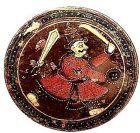
Decorated Deck Example
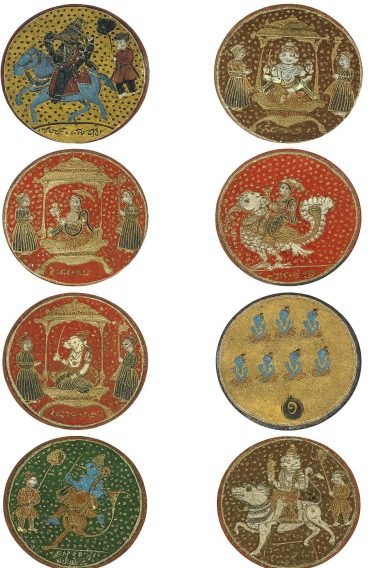
Themes and Symbolism
Dashavatara Ganjifa
Dashavatara Ganjifa is one of the best-known forms of the game and is based on the ten avatars of Vishnu. A common version uses ten suits of twelve cards each, with each suit associated with one avatar. [web:96][web:103][web:106]
- Matsya – Fish, linked with rescue and renewal.
- Kurma – Tortoise, associated with support and stability.
- Varaha – Boar, linked with protection and restoration.
- Narasimha – Man-lion, symbol of divine protection.
- Vamana – Dwarf, associated with humility and righteousness.
- Parashurama – Warrior sage, linked with justice and valor.
- Rama – The ideal king and hero.
- Krishna or Balarama/Krishna – Divine wisdom and play.
- Buddha or Jagannath/Buddha – Compassion and spiritual teaching.
- Kalki – The future restorer of order.
Navadurga Ganjifa
Another important variation, especially in Odisha, is Navadurga Ganjifa, which represents the forms of Goddess Durga and emphasizes the power of the divine feminine. [web:97][web:103]
Design and Craftsmanship
Ganjifa cards were traditionally made by hand on materials such as paper, cloth, wood, palm leaf, ivory, and other supports, depending on the region and patronage. Circular cards are especially well known, particularly in Odisha, though rectangular forms also existed. [web:100][web:103][web:106]
They were painted with natural pigments and often decorated with floral borders, deity symbols, court figures, and narrative imagery. Royal and elite sets could include more elaborate finishes and fine detailing. [web:97][web:100][web:102]
Regional Art Styles
- Odisha: Dashavatara and related decks painted in Pattachitra style. [web:97][web:103][web:106]
- Sawantwadi, Maharashtra: Hindu and Mughal-influenced themes, with a strong revival tradition. [web:96][web:102][web:105][web:108]
- Mysore: Regional decks linked with local painting traditions. [web:109]
- Other regions such as Bengal, Telangana, and Gujarat also preserved distinctive Ganjifa forms. [web:104][web:107][web:109]
The Setup
- The dealer shuffles the deck thoroughly.
- Cards are dealt equally among the players.
- Any remaining cards may be set aside face down depending on the variation.
Historical forms could be played by two or more players, and some regional decks used large suit counts and larger packs than modern standard playing cards. [web:96][web:100][web:103]
The Play
Ganjifa is generally a trick-taking card game. While the exact rules vary across regions and decks, the usual aim is to win tricks through suit-following, memory, and careful hand management. [web:96][web:100][web:101]
Playing Method
- The player to the dealer’s left leads the first card.
- The next player follows with the same suit if possible.
- If a player does not have the suit, another card may be played.
- The highest-ranking card of the lead suit takes the trick.
- The trick winner collects the cards and leads the next round.
- Play continues until all cards have been used.
Winning the Game
The player who wins the greatest number of tricks, or the highest valued tricks in some local systems, is declared the winner. [web:100][web:101]
Skill and Strategy
- Memory, to recall which suits and ranks have already appeared.
- Strategy, to manage strong and weak suits effectively.
- Observation, to read opponents’ likely holdings and intentions.
Because of this, Ganjifa functioned not only as entertainment but also as a test of composure and intellect. [web:100][web:101]
Cultural Significance
Ganjifa is important not just as a game, but also as a carrier of mythology, painting traditions, and moral storytelling. Through themes such as Dashavatara and Navadurga, it connects play with narrative, devotion, and symbolic education. [web:97][web:99][web:103]
It also helped sustain artisanal traditions, as painters and card-makers passed down methods across generations. In some places, the cards became part of broader cultural and ritual contexts rather than mere pastime objects. [web:97][web:102][web:109]
Contemporary Relevance
Today, Ganjifa survives both as a heritage game and as a valued art form. Artisans and institutions in places such as Puri and Sawantwadi continue to revive, produce, and teach these cards as part of India’s intangible cultural heritage. [web:98][web:102][web:105][web:109]
Museums, educators, and cultural organizations increasingly use Ganjifa to introduce learners to art history, mythology, and traditional game design. [web:98][web:106][web:109]
Notes
Kreeda Patram or Ganjifa represents a remarkable fusion of art, intellect, and devotion. It transforms card play into a form of cultural expression rooted in painting, storytelling, and memory. [web:96][web:97][web:102]