Kokla Chappaki
Traditional Sport of India
Rumal Chor / Kokla Chapakki
Rumal Chor, also known as Kokla Chapakki, is a lively traditional outdoor circle game played by children in Punjab and many other parts of India. It is simple, playful, and full of laughter, combining alertness, speed, rhythm, and surprise.
About the Game
Rumal Chor is a fun group game in which one player secretly drops a handkerchief behind another player sitting in a circle. The chosen player must notice it quickly, pick it up, and chase the runner before the runner takes their place.
The game is easy to organize, needs very little equipment, and is best enjoyed with a larger group. It is more about excitement, participation, and community fun than about a final winner.
Traditional Play Scene
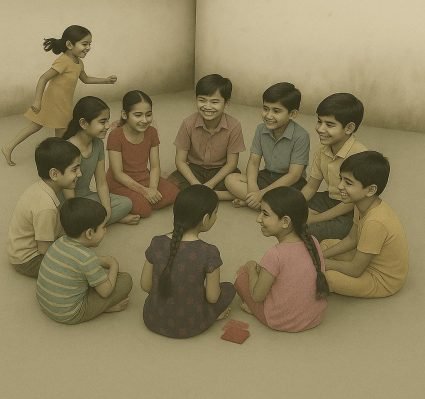
The Setup
The setup is simple and works best in an open area where players can sit comfortably in a circle.
Players
At least 6 players, though more players make the game more exciting.
Space
An open area where everyone can sit in a circle.
Main Object
A small cloth, handkerchief, or similar item used as the kokla or rumal.
Arrangement
Players sit facing inward with a little space between each person.
The Play
One player begins as the runner and carries the kokla while moving around the outside of the circle. The seated players remain alert while the runner tries to secretly drop the cloth behind someone.
Starting the Game
- All players sit in a circle facing inward.
- One player becomes the runner and holds the kokla.
- The runner walks or runs around the outside of the circle.
- During play, the group often sings a traditional rhyme.
Placing the Kokla
- The runner quietly drops the cloth behind one seated player.
- The chosen player must notice the cloth as quickly as possible.
Chasing
- Once the seated player notices the kokla, they pick it up and chase the runner.
- The runner tries to go around the circle and sit in the now-empty place.
Rhymes and Singing
Singing is an important and joyful part of the game, and different regions use different rhymes. In Punjab, a well-known line begins with Kokla Chapakki, while other regions have their own local versions.
The song adds rhythm, excitement, and suspense as the runner moves around the circle.
Outcomes
- If the runner reaches the empty place and sits down safely, the chaser becomes the new runner.
- If the runner is caught before sitting down, the group may give a small fun penalty such as singing or dancing.
- The new runner takes the kokla, and the game continues.
The game usually has no fixed ending and is played mainly for enjoyment, laughter, and active participation.
Strategy
For the Runner
- Use deception by pretending to drop the cloth behind different players.
- Keep moving naturally so the actual drop is not noticed quickly.
- Run fast once the chosen player discovers the kokla.
For Seated Players
- Stay alert and aware of movement behind you.
- Watch the runner closely without turning too much.
- React quickly once the cloth is discovered.
Skills Developed
- Alertness and observation.
- Quick reaction and speed.
- Rhythm and group coordination.
- Social interaction and joyful participation.
- Confidence in playful public activity.
Cultural Value
Rumal Chor reflects the simple beauty of traditional Indian children’s games, where a single cloth and a group of friends are enough to create energy, suspense, and laughter.
It continues to be remembered as a game of community spirit, song, playful surprise, and shared childhood experience.