Khuchaman
Traditional Sport of India
Khuchamani
Khuchamani is a traditional outdoor game from Gujarat in which players throw a thin pointed stick into soft ground and try to make it pierce the soil deeply. The game is simple, competitive, and skill-based, developing focus, control, and precision.
About the Game
Khuchamani is a traditional group game played in open spaces, especially when the soil is moist enough for a pointed stick to enter the ground. The challenge lies in throwing the stick at the correct angle and with enough force so that it pierces the earth.
The game is easy to organize, requires very little equipment, and encourages natural outdoor play through accuracy, patience, and friendly competition.
Origin
Khuchamani is associated with rural communities of Gujarat and nearby parts of north-western India. Similar forms of the game are also known in surrounding regions, with local changes in name and style.
Traditionally, the sticks used in the game were made by local artisans from iron or strong wood, showing the close link between village craftsmanship, environment, and play culture.
Traditional Form
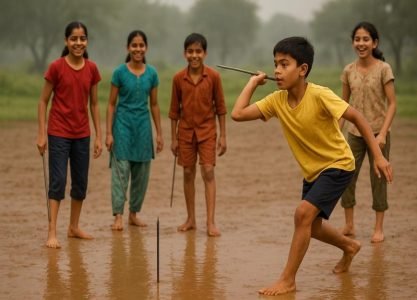
The Setup
Throwing Stick
The main object used is a thin rod-like stick, usually about 25 to 40 cm long, made of strong wood or iron and sharpened at one end.
Playground
The game is played on a flat patch of soft, moist soil where the pointed end can enter the ground properly.
- Select a flat open area with wet or softened soil.
- If the ground is too dry, sprinkle water to make it suitable.
- Draw a throwing line from where players will take turns.
- Mark distance zones or target areas if scoring is based on location as well as depth.
Markers
Pebbles or small stones may be used to mark positions, scoring points, or depth comparisons.
Players
Usually 2 to 10 players can take part. The game is played individually, but turns rotate in a group format.
The Play
- Players decide the turn order by agreement or a simple method such as tossing the stick.
- The stick is held from the blunt end.
- It is thrown in a downward arc toward the soil.
- A valid throw is one in which the pointed end pierces the ground and remains standing or clearly embedded at an angle.
- If the stick falls flat or bounces away, the attempt counts as a miss.
- Each player gets the same number of throws in a round.
Scoring
- The main score is based on depth of penetration into the soil.
- Players may compare depth using visible markers or small stones.
- In some local versions, distance from the throwing line also adds to the score.
Winning
The winner is the player who achieves the deepest successful pierce or the highest total score over several rounds.
Variations
| Variation | Description |
|---|---|
| Distance Throw | Players throw from increasing distances after each round. |
| Target Spot Throw | A small marked circle is used as the target and accuracy is rewarded. |
| Team Relay | Teams compete with each player contributing one throw per cycle. |
Skills Developed
Physical Skills
- Hand-eye coordination.
- Wrist strength and control.
- Judgment of angle and throwing force.
Mental and Social Skills
- Focus and patience.
- Strategy and consistency.
- Group interaction and healthy competition.
Safety Measures and Cautions
Since Khuchamani uses a pointed stick, careful supervision and safe spacing are essential.
- Players should stand well apart from one another.
- No one should stand in the direction of a throw.
- The stick should only be thrown forward and never waved or pointed toward others.
- Younger children should always play under supervision.