Khalai Sbai
Traditional Sport of India
Khalai Sbai / Lehkai Sbai / Kawang Kot
Khalai Sbai is a traditional children’s aiming game played in Meghalaya, especially among Khasi and Jaintia communities. It is a simple but skill-based game that uses everyday materials and helps develop precision, control, and concentration.
About the Game
Khalai Sbai is a traditional outdoor game in which players aim at small target objects placed inside a marked circle and try to knock them out using a throwing stone. The game is easy to set up, needs very few materials, and reflects the creativity and joyful community life of childhood play.
It is both recreational and developmental, since players must judge distance, direction, and force with care. The game naturally strengthens concentration, hand-eye coordination, and control.
Origin
Khalai Sbai belongs to the traditional play culture of Meghalaya and is especially associated with Khasi and Jaintia communities. Like many indigenous games, it grows out of the practice of turning ordinary natural or household materials into objects of play.
The game reflects resourcefulness and sustainability, as children often use broken pottery, bone china pieces, or stones instead of specialized equipment.
The Setup
Materials Required
Target Pieces
Broken bone china pieces, clay pot fragments, or flat stones.
Throwing Stone
One smooth stone used to strike the targets.
Ground
An open, level space, preferably with soft soil or sand.
Marking Tool
Chalk or a stick to draw the circle and throwing line.
The use of discarded or natural items in the game highlights creativity, sustainability, and the traditional practice of making play from everyday materials.
Game Materials
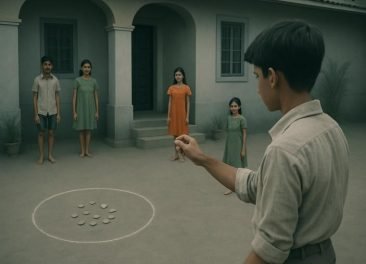
Preparing the Ground
- Draw a circle on the ground, usually about 2 to 3 feet in diameter.
- Place the target pieces inside the circle in a small pile at the center.
- Mark a throwing line about seven to ten steps away from the circle.
- Make sure the ground is flat and safe for all players.
The game may be played by two or more players and is generally suitable for children aged six years and above.
The Play
Method of Playing
- The first player stands behind the throwing line and throws the stone toward the targets inside the circle.
- The aim is to push one or more target pieces completely out of the circle.
- If the player succeeds, the displaced pieces are collected and kept by that player.
- The same player continues until they miss.
- If no piece is knocked out, the turn ends and the next player begins.
- The game continues until all target pieces have been struck out and collected.
Winning the Game
- At the end of the game, each player counts the pieces collected.
- The player with the highest total is declared the winner.
- The game rewards both accurate aim and consistency over multiple turns.
Regional Variation: Kawang Kot
A related version called Kawang Kot is played in some parts of Meghalaya and nearby regions. In this variation, cards made of paper or cardboard are used instead of pottery or stone pieces.
- A circle is drawn and equal-sized cards are scattered inside it.
- The throwing line is placed about 9 to 10 feet away.
- Players throw small stones to knock the cards fully out of the circle.
- Touching or tilting a card without pushing it out does not count.
- The turn passes after a missed attempt.
- The player who collects the most cards wins.
This variation shows how traditional games adapt naturally to local materials and changing play styles.
Benefits
Physical and Cognitive Benefits
- Develops aiming accuracy and hand-eye coordination.
- Teaches control of force and distance.
- Strengthens finger, wrist, and hand muscles.
- Improves concentration and patience.
Social and Emotional Benefits
- Encourages fair play and turn-taking.
- Supports peer interaction and friendly competition.
- Builds composure under light competitive pressure.
- Creates a sense of community and shared enjoyment.
Cultural Significance
Khalai Sbai reflects the traditional philosophy of simple, mindful play using natural or easily available materials. It shows how indigenous communities connect learning, creativity, and recreation in everyday life.
By preserving games like this, communities keep alive local childhood traditions and a sustainable, resourceful approach to play.