Kanche / Marbles
Traditional Sport of India
Goti / Kanche / Gulli / Marbles
Marbles are among the most beloved traditional children’s games in India. Known by names such as Goti, Kanche, Gulli, and Akkha, the game combines aim, finger control, strategy, and friendly competition using small colorful marbles.
About the Game
Bright, round marbles made of glass, clay, stone, or similar materials have attracted children for generations. Many different games are played with marbles, but most versions depend on aiming skill, force control, and accurate finger flicking.
The word Kanche comes from Kaanch, meaning glass. In many versions, players try either to knock marbles out of a marked circle or to send them into a pit.
Traditional Marbles

Origin
Marble-like play objects have a very long history in the Indian subcontinent. Archaeological excavations from ancient sites such as Mohenjo-Daro, Harappa, and Lothal have revealed small spherical objects made of clay, stone, and terracotta.
These discoveries suggest that round objects similar to marbles were known in early Indian civilizations, whether for play, ritual, or both. Over time, marble games became a cherished part of childhood across India.
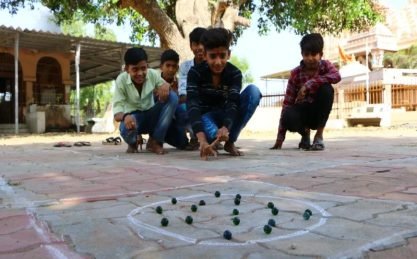
Typical Arrangement
Historical Connection
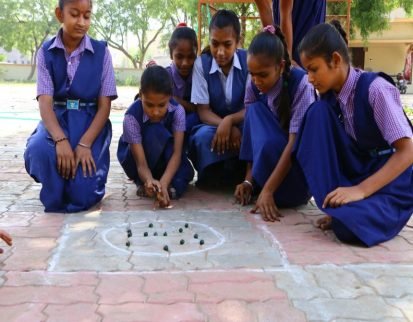
The Setup
Items Needed
Marbles
A set of small glass, stone, or clay marbles.
Play Area
A flat, open space on the ground.
Circle
A circle drawn on the ground, usually about 1 to 2 feet in diameter.
Target Line
A line marked some distance away from the circle.
Setting the Ground
- Draw a circle on the ground.
- Mark a target line at a fixed distance from the circle.
- Each player places an agreed number of marbles inside the circle.
- Players choose a striker marble, often slightly larger and personally favored.
The Play
- Each player flicks their striker, and the one landing closest to the target line usually begins.
- The first player throws or flicks the striker from the target line toward the circle.
- After all players have taken their opening turn, later turns begin from where each striker rests.
- Players then try to strike marbles out of the circle using their striker.
- The usual flicking action is done with the thumb and fingers while kneeling near the striker.
- If a player knocks marbles out successfully, those marbles are collected and the turn continues.
Rules During the Game
- If the striker remains inside the circle after the shot, the player may lose the turn.
- The striker is then picked up, and the next player continues.
- Players must follow the agreed local rules for shooting, collecting, and turn order.
Winning the Game
The player who collects the greatest number of marbles by the end of the game is the winner.
Variations
- Longer distance targets can be used for more advanced play.
- Some groups assign extra value to certain colors or special shots.
- Local rules may differ from region to region.
The Dhoos Method
Dhoos is a very popular marble game format in which players try to knock marbles out of a circle. It emphasizes aim, tactical striking, and the ability to collect marbles through repeated successful shots.
The Gabbi Method
In the Gabbi variation, a small pit called the Gabbi becomes the center of play. Instead of knocking marbles out of a circle, players aim to send their marbles into the pit.
Gabbi Setup
- A small pit is dug into the ground.
- Players agree on how many marbles each will contribute.
Playing Method
- Players take turns flicking their marbles toward the Gabbi from a distance.
- The objective is to get the marble into the pit.
- If a marble enters the Gabbi, the player may win the marbles in the pit or continue as per the agreed rule.
- If the marble misses or is knocked away, the turn ends.
Winning
The player who collects the most marbles by the end wins the Gabbi game.
Gabbi and Dhoos
| Method | Main Focus |
|---|---|
| Gabbi | Getting marbles into a pit |
| Dhoos | Knocking marbles out of a circle |
Gabbi relies more on precision distance control, while Dhoos places greater emphasis on tactical targeting and collection.
Benefits
Physical and Mental Skills
- Improves hand-eye coordination.
- Strengthens finger control and fine motor skill.
- Develops force judgment and aiming accuracy.
- Encourages concentration and tactical thinking.
Social Benefits
- Promotes friendly competition.
- Encourages group play and interaction.
- Supports turn-taking and fair play.
- Creates lasting childhood memories and community bonding.
Cultural Significance
Marble games such as Gabbi and Dhoos are a cherished part of Indian childhood, especially in regions like Gujarat and many other parts of the country.
They reflect the simplicity, creativity, and skill-based joy of traditional play, where a few small objects can create deep engagement and community connection.