Jod Saakali
સાંકળ સાત્તાળી | जोड़ साखळी | Son-Sakali | Chain Tag | Blob | Gargon
Introduction
The game Jod Saakali (chain) is a unique form of the classic run-and-chase game. It is played by running together with linked hands and involves group moves and coordination. The game consists of a chaser whose aim is to run and catch the other players. Once the chaser catches a player, that player joins hands with the chaser, and they both now chase together. When their pair has caught the third player, then this player also gets added. The chain, now formed of three players, chases other players, and so on.
Other Names
| Maharashtra | Jod Saakali, Son Sankali |
| Gujarat | Sankal Sattali |
| Netherlands | Blob, Gargon |
| Region | Name |
| Australia, New Zealand | Gang up Tiggy |
| USA, United Kingdom | Chain tag |
The Play
The game tests the stamina, coordination with the other runners and escape tricks of each player.
Number of Players
The game is enjoyable with six or more players. We suggest a maximum of 12 players. The beauty of this game is that more players can join in at any stage during the game.
Playground
This game is an outdoor game that involves running and chasing. So any open ground with an even surface and without potholes—grass fields, school compounds, streets, parks—will be suitable for playing. Mark a boundary according to the number of players. To give you an idea, an area measuring 60 ft. x 60 ft. will suffice for 10 players.
Equipment
No equipment or any arrangement is needed to play this game except for marking boundary lines.
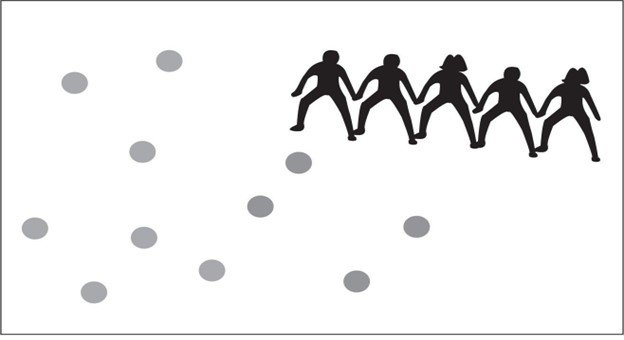
Players in the dark are chasers and the dots are runners.
Playing Method
Start the game by selecting a chaser. Other players in the group will be the runners.
- All the players spread out in the playfield. On the captain’s signal, the chaser starts to chase the other players and catches anyone possible.
- After the first runner is caught, the player joins the first chaser as an integral member of the chasing team.
- Both chasers now hold each other’s hands and run together to catch the next runner.
- As the chasers catch more runners, these runners join the chasing team. They join hands to form a chain and chase the remaining runners together. As both the hands of the chasers are locked in the chain except for those at the end, only the two chasers at the end can tag a runner with their free hand.
- Eventually, the chain of chasers becomes longer, and the game continues until all other players are linked in the chain except the last one.
- The first runner to get caught gets one point; the second player to get caught gets two points and so on. The last player gets the maximum points and wins the innings.
- Players can choose to play more innings, and the points gained by the players in the second innings will be added to the points from the first innings. As they play more innings, the points will get added.
- The player with the maximum points at the end of the game is declared the winner.
- Runners are allowed to move around the playing area and have to stay away from the chain chasers.
Scoring
The score gained is based on the order in which a runner is caught. The first person to get caught gets the least points, and the points increase in the order of getting caught.
The first runner to get caught gets one point, the second two points, and so on. The last player gets the maximum points. If there are nine players, then the last player standing gets eight points and is declared the winner for the innings.
Rules
- The hands of all the chasers must be locked in the chain at all times. The players in the middle can’t unlock their hands and tag runners independently.
- If the chain is broken at the time of tagging a runner, then this tag is not valid.
- The runners who move out of the boundary are automatically ruled out of the group and join the chain of chasers to catch the remaining players.
- The chain must not be broken, and it goes on increasing in length as more players join.
- The player who is caught first will be the chaser of the next game.
Positions, Tasks and Techniques
| Roles | Positions | Tasks | Strategy | Techniques |
| Chaser | Initially take the position at any corner of the ground. | Chase and catch the runners who are spread out randomly and run in the field. Pair with the first person tagged and progressively form a chain of chasers. Make as many players as possible join the chaser’s chain. |
As there are many individuals in the chain with a common objective, coordination is the key. Pick one runner at a time to chase and communicate accordingly. Let all the new members take the lead from the first chaser to ensure coordination. As the length increases, running together may be difficult. So, a slow run or a walk may be preferred. |
| Runners | Take random positions on the ground. | Escape the chasers and keep evading. Let the chasers catch the other runners. | Run through narrow areas where the chain of chasers cannot reach. Rapidly change direction to make it difficult for chasers to follow instantly. |
Variations of the game
- In some variations, the chaser throws a ball at the targeted runner, instead of touching. The original chaser and the new joiners use the ball to tag the runners.
- In the original game when the chasers catch the fourth player, the chain is divided into two groups of two. The next player becomes the third member of a chain. But when the next runner is tagged, the last two players make a separate chain. So, at any time, a maximum of three persons can form a chain.
- Make a safe zone. It might be one of the sides on the playground or a tree or a bench or a space marked out with chalk. When a runner reaches this area, they are safe from being tagged. A time limit is set for staying in the safe zone.
Key Skills Required
- Coordination: This game requires players to move while linked to other players.
- Communication: Players should be able to convey and grasp the messages about the next activity without using verbal interaction.
This game can be played by any individual of age six to eighteen years. The senior players also enjoy this game with people of the same age group. Any player who is an average runner and knows the tag games can enjoy the game.
Skills Developed
Children learn skills like running, evading, cooperating and being inclusive in a group setting. They learn to accept and follow the decisions of the group or the leader. Uniquely, in this game, the players learn to manage their personal feeling of enthusiasm and eagerness in accordance with the group decision. The game enhances coordination and team spirit, especially in children.
Cautions
While moving together in a chain, the chasers should be careful to maintain the same running speed as the group so as not to stumble or fall. The stronger chasers in the chain should be careful not to pull their partners too hard, forcing them to match their speed.
Life Lessons
The game conveys a message of teamwork. The chasers can spread out in a larger area as a chain and can quickly catch the runners.
At the same time, there is a negative side—the ‘excessive resource’ problems. Many groups, families or organisations that grow large are unable to align individual resources towards a joint objective. Many individuals often pull in opposite directions, dragging down the entire organisation. So, the variation of the game where the chain is broken into smaller chains provides better management.
Current State
The game is still popular as a favourite pastime in school recesses as it can be played without any planning.
Similar Games
| Regions | Names |
| Western countries | Reverse tag/Zombi tag |
| Romania | Leapsa |
| Modern Greece | Kynigito |
Glossary
| Sakali | A chain. Chasers link hands and move together to catch the runners. |
| Jod | A linkage or a connect |
| Sankal sattali | ‘Seven claps forming a chain’ referring to seven chasers joining hands to form a chain |
| Son saakali | A golden chain |