Inkabiwah
Traditional Sport of India
Inkawibah / Kolokpa
Inkawibah is a traditional seed-striking game played in Mizoram and linked with regional variants in other parts of Northeast India. It is a game of focus, control, and precision in which players aim to hit or scatter seeds from a fixed distance.
About the Game
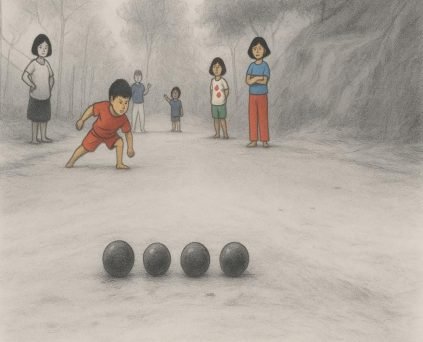
Inkawibah is a traditional outdoor game played widely among Mizo children and sometimes by adults. It uses large seeds called Kawi and is based on striking, scattering, or displacing target seeds with a striker seed.
The game shares some similarities with marbles and other aim-based traditional games, but it has its own distinctive Northeastern identity and regional methods of play.
Origin
The game comes from a rural tradition in which children used natural materials such as stones, nuts, and seeds to create competitive skill games. The smooth and durable Kawi seed became especially suitable for striking and aiming games.
Over time, different local forms developed across Mizoram and neighboring areas, while the core spirit of the game remained the same: strategy, precision, patience, and fair competition.
The Setup
Players
There is no fixed number of players. The game may be played by individuals or by two teams, although very large groups are usually avoided for easier play management.
Equipment and Playground
Kawi Seeds
Usually 50 to 60 medium or large sea seeds used as targets and striker pieces.
Surface
A flat and smooth outdoor ground is preferred.
Optional Board
Some versions use a flat wooden board as part of the target setup.
Play Style
Players strike arranged seeds from a marked distance using one seed as a striker.
Game Materials
The Play
The aim of the game is to hit or displace the arranged target seeds by using a striker seed. Players earn points or collect seeds based on the number of successful strikes.
Starting
- Players mark a striking line on the ground.
- A row, pile, or standing arrangement of seeds is placed at a fixed distance from the line.
- Each player keeps one seed as a striker.
- The play area should be flat and clear so that the seeds move fairly.
Rules
Turn-Taking
- Players or teams take turns from behind the striking line.
- Only one attempt is allowed per turn.
Striking Method
- The striker seed may be flicked, rolled, thrown, or slid depending on the local method.
- The aim is to hit or scatter the arranged target seeds.
Scoring
- Each displaced seed may count as one point or become the property of the player or team.
- Seeds placed farther away may have higher value in some versions.
- Hitting the central pillar or special target may earn bonus points or additional seeds.
Winning the Game
- The game ends when all arranged seeds have been hit, scattered, or claimed.
- The player or team with the highest number of seeds or points wins.
Arunachal and Mizoram Variant
In one important team version, two groups stand on opposite sides of a central pillar made of five vertically stacked seeds. On both sides of this pillar, pairs of seeds are arranged in rows.
- Teams take turns striking the arranged pairs with their striker seeds.
- Any successfully hit pairs are collected by the striking team.
- If the central pillar is scattered, the team can collect extra pairs from its side.
- If a player misses, the turn passes to the opposing team.
- The game continues until one team clears all its seeds, and that team wins.
Regional Variations
Variation 1 – Spinning Seed Method
- Small piles of three seeds are arranged at equal intervals.
- Players spin their striker seed toward the piles from a set distance.
- Any seeds that are successfully scattered are collected.
- The player with the highest number of collected seeds wins.
Variation 2 – Target Board Method
- A wooden board is set upright using a support such as a brick or stone.
- A target line and starting line are marked at fixed distances.
- Players throw seeds so that they strike the board and rebound toward the target pile.
- Turn order may be decided by whose seed lands closest to the pile.
- The game continues until all seeds are won.
Benefits to Players
Physical and Mental Skills
- Improves concentration and aim.
- Develops fine motor control and hand-eye coordination.
- Builds patience and self-control.
- Encourages planning and tactical play.
Social and Cultural Value
- Promotes teamwork and fair play.
- Supports group interaction and community play.
- Preserves traditional Mizo and Northeastern game culture.
- Shows creative use of natural local materials.
Safety and Precautions
- Play in an open space so seeds do not bounce toward faces or eyes.
- Avoid throwing too hard.
- Younger children should play under supervision.
- Keep the seed arrangement fair and do not alter it during the game.