Gulel/Slingshot
Traditional Sport of India
Gulel (Slingshot)
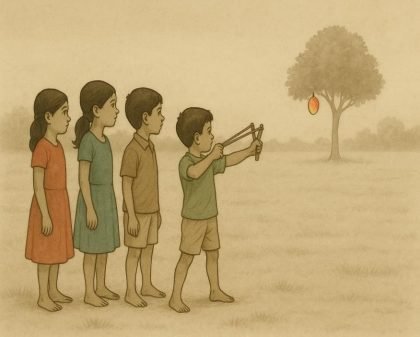
The Gulel is a traditional slingshot made from a forked stick and an elastic band. Once used in rural life for practical purposes, it is now presented as a skill-based activity focused on aim, precision, coordination, and control.
Origin
The Gulel emerged from India’s long tradition of resourceful outdoor play, where children and villagers created useful tools and games from natural materials such as wood, rope, rubber, and stone.
In rural life, it was often used for practical tasks such as protecting crops from birds or for small-scale hunting. Over time, it also became a playful challenge of skill, patience, and precise aim.
A traditional handmade gulel usually began with a strong forked branch that was shaped, smoothed, and fitted with a leather or rubber band system. This process itself taught craftsmanship, patience, and care.
Cultural Reference
Traditional Indian literature also contains references to devices made with rope and stone for throwing or knocking down fruits. Such references help place the idea of projectile play and training within a broader history of Indian physical culture.
The Setup
Main Equipment
A gulel, safe pellets, and one or more targets.
Projectiles
Soft paper pellets, rubber pellets, or other safe school-use materials.
Target Area
A clear open space with fixed targets placed at a safe distance.
Purpose
To hit the target accurately while maintaining safe handling and control.
The Play
Beginner Level
Players first learn how to hold the gulel properly, pull the band evenly, and release it smoothly. Practice should begin with soft projectiles such as paper or rubber pellets.
Intermediate Level
At this stage, players begin aiming at fixed targets from a short distance of about 2 to 3 meters. Accuracy records can be kept to help monitor progress.
Practice Stage
Advanced Practice
At advanced levels, players work on longer distances, angle adjustment, consistency, and controlled focus under time pressure. Precision becomes more important than raw force.
Safety First
- Never point the gulel toward people or animals.
- Use only soft or rubber-based pellets for school activities.
- Always make sure the space ahead is clear before shooting.
- Wear eye protection when stronger elastic bands are used.
- Inspect the bands regularly and replace worn or cracked parts.
- Training and competitions should be supervised by a teacher or adult.
Guidance for Schools
- Form individual or team events by age group or class level.
- Set up safe targets such as bottles, paper boards, or balloons.
- Define clear distances, number of chances, and scoring rules.
- Reward discipline, safety, and accuracy along with performance.
- Add creative rounds such as themed targets or team challenge formats.
In school-style competition formats, participants may be given 5 to 7 attempts to hit a required number of targets.
Gulel in Modern Times
Today, the gulel is increasingly being presented as a safe outdoor precision activity rather than a hunting tool. Hobby groups and schools may use it to teach control, concentration, and responsibility.
Educational Value
Skill Development
- Builds hand-eye coordination and motor control.
- Improves patience, focus, and disciplined movement.
- Encourages controlled strength and accurate aiming.
- Promotes outdoor engagement and teamwork.
Competitive and Recreational Use
- Bottle or can shoot events.
- Balloon popping challenges.
- Timed target rounds.
- Accuracy-based school or hobby competitions.
Cultural Value
In many regions, the gulel symbolized cleverness, readiness, and a playful test of aim. Older generations often remember friendly target challenges held in farms, fields, or open grounds.
The Science Behind the Gulel
The gulel offers a clear practical example of basic physics. When the elastic band is pulled back, potential energy is stored, and when it is released, that energy becomes kinetic energy that sends the projectile forward.
- Elasticity and tension.
- Trajectory and angle of launch.
- Force and speed relationship.
Because of this, the gulel can also be used as a simple teaching aid in science lessons.