Chhupam Chhupai
Traditional Sport of India
I Spy Dabba Spy
I Spy Dabba Spy is a traditional outdoor children’s game played in many parts of India. It combines hiding, guessing, chasing, and guarding a central object called the dabba.
About the Game
I Spy Dabba Spy is a lively guess-based variation of hide and seek. One player becomes the Spy, while the others hide and try either to stay undetected or to sneak back and knock the dabba out of the circle.
The game is simple to organize and uses basic household items, which has made it a long-standing favorite in streets, courtyards, and open spaces across India.
Origin
The game is rooted in Indian street and neighborhood play, where children often created imaginative games using common objects and open spaces. It reflects a tradition of resourceful outdoor recreation based on observation, agility, and group interaction.
Regional names differ across India, and local versions of the game may vary slightly in style and rules, but the core idea remains the same: hide, watch, guess, and protect the dabba.
The Setup
Items Needed
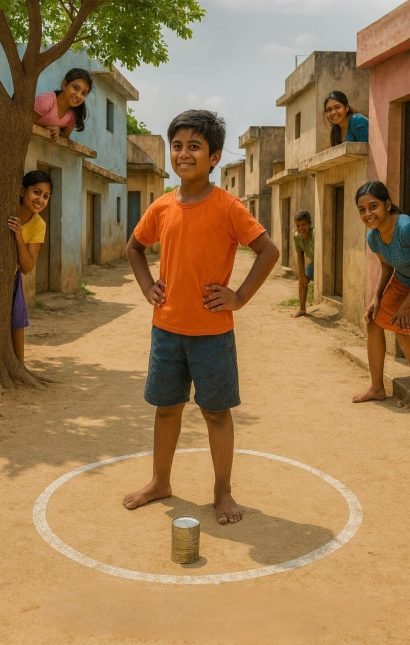
An empty tin, can, or plastic box used as the dabba.
Marking Tool
Chalk or any marker to draw a circle on the ground.
Play Area
Any safe outdoor space such as a yard, lane, garden, or playground.
Players
One Spy and several hiding players.
Game Setup
The Play
The main goal of the Spy is to identify hidden players correctly and stop them from knocking the dabba out of the circle. The hiding players try to remain unseen and wait for the right moment to escape and strike the dabba.
Starting the Round
- Draw a clear circle on the ground and place the dabba in the center.
- Choose one player to be the Spy.
- One hiding player throws the dabba away from the circle.
- While the Spy runs to fetch and replace it, the other players run and hide.
Spy on the Move
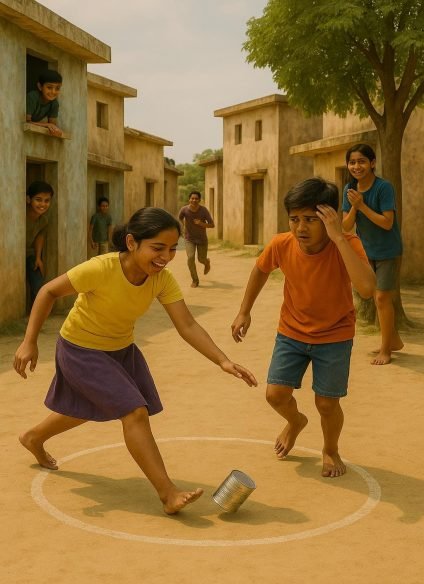
- The Spy searches for the hidden players while staying aware of the dabba.
- The Spy tries to identify players by guessing their name and hiding place.
- The Spy cannot rely only on close chasing; observation and memory are important.
Guess and Call Out
- If the Spy correctly identifies a player, they run back to the circle and call it out loudly.
- The identified player becomes the next Spy in the following round.
- If the guess is wrong, the same Spy continues in the next round.
Knock the Dabba
- While the Spy is away searching, any hiding player may try to sneak back.
- If a player touches or kicks the dabba out of the circle, the Spy loses that round.
Safe Zone
In some versions, the Spy may stand on or touch the dabba as a temporary safe zone. If the dabba is knocked away while the Spy is on it, the round is reset.
Spy Guarding the Dabba
Rules
- The Spy must replace the dabba before beginning the search.
- Hiding players must avoid being seen or correctly identified.
- The Spy must return to the circle to announce a correct guess.
- If the dabba is knocked out of the circle, the round ends in favor of the hiders.
- The game continues in multiple rounds with players taking turns as Spy.
Winning
Each round ends either when the Spy correctly catches and calls out a player, or when a hiding player successfully knocks the dabba out of the circle.
The game is usually played for repeated rounds rather than for one final winner.
Skills Required
- Sharp observation.
- Guessing from small clues such as clothing or movement.
- Quick decision-making.
- Agility and stealth.
- Risk assessment and timing.
The Spy must often identify players from a distance while staying close enough to protect the dabba.
Lessons from the Game
I Spy Dabba Spy builds physical agility, strategy, patience, and awareness. It also encourages teamwork, social interaction, and creative outdoor play with minimal resources.
The game remains a strong example of how traditional Indian children’s games combine imagination, movement, and community participation.