• Home
  • Bharatiya Khel
    • About the program
    • Vision and Mission
    • The list of 75 games
    • FAQ
  • Game of the month
    • Game of the month (Kabaḍḍi/Hututu)
    • Previous Games
    • Training material: (Kabaḍḍi/Hututu)
    • Upcoming games
  • Community
    • Our Members
    • Wining Teams
    • Teacher of the month
    • Join Us
  • Video Upload
  • Register
  • Gallery
  • Contact us
  • Home
  • Bharatiya Khel
    • About the program
    • Vision and Mission
    • The list of 75 games
    • FAQ
  • Game of the month
    • Game of the month (Kabaḍḍi/Hututu)
    • Previous Games
    • Training material: (Kabaḍḍi/Hututu)
    • Upcoming games
  • Community
    • Our Members
    • Wining Teams
    • Teacher of the month
    • Join Us
  • Video Upload
  • Register
  • Gallery
  • Contact us
  • Home
  • Bharatiya Khel
    • About the program
    • Vision and Mission
    • The list of 75 games
    • FAQ
  • Game of the month
    • Game of the month (Kabaḍḍi/Hututu)
    • Previous Games
    • Training material: (Kabaḍḍi/Hututu)
    • Upcoming games
  • Community
    • Our Members
    • Wining Teams
    • Teacher of the month
    • Join Us
  • Video Upload
  • Register
  • Gallery
  • Contact us

Chaupad

Chausar | Sogata baji | Dayakattai | Pagadi pat | Sokkatam

Introduction

Chaupad is one of the oldest board games from India that dates back thousands of years. It is considered a precursor to modern games like Ludo. Beyond its entertainment value, Chaupad holds deep cultural and historical significance. It is mentioned in the epic Mahābhārata where the game plays a pivotal role in the narrative.

Known in different regions and variations as Pachisi, Dayakattai, or Naalparam, Chaupad embodies ancient strategies (yukti) and the interplay of skill (kaushala) and chance (daiva). Chaupad is said to be the national board game of India. It is called as Pagade (Kannada), Chaupar/Chausar(Hindi), Sogatabaji (Gujarat/Rajasthan), Sokkattan (Tamil), Dayakattam (Tamil), Pagdi Pat (Marathi), Parcheesi (English – USA).

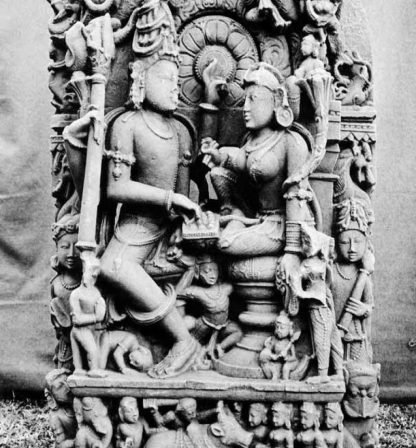
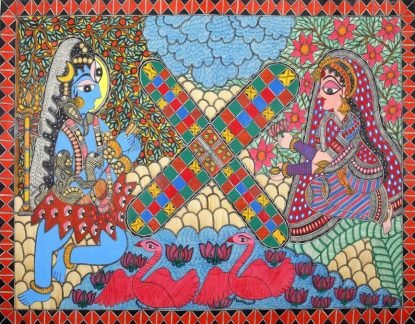
Lord Shiva and Parvati playing chaupad

Origin

In the Mahābhārata, the game of dyūta (dice) sets the stage for key events, symbolizing human tendencies toward competition, fate, and decision-making. Chaupad thus serves as an example of how leisure activities were interwoven with dharmic lessons in ancient society.

According to an article (in the DNA) by Roshni Nair, Irving Finkel,

the author of Ancient Board Games Irving said, “The English tore

the rule book and created an alternative requiring not the slightest response of the soul. They took the good out of that game, repackaging and importing it to India as stupid, anodyne Ludo… Now I see Indians playing Ludo, totally oblivious about the damn good game their forefathers played.

The Setup

The objective is to move all four pieces once around the outer squares of the board, then into the central column (‘gṛha-mārga’) and finally into the hṛdaya-sthāna (home), before opponents do.

Equipment needed

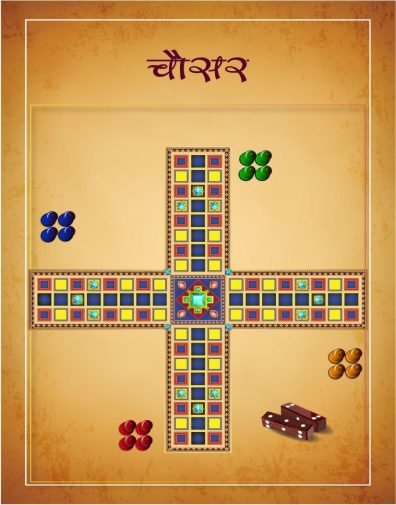
  • Board: Cross-shaped board divided into 4 arms + central home (Charkoni)
  • Pieces (Gotis): Each player gets 4 pieces of same color
  • Dice (2): Traditional cowries 6 or wooden dice (1–6 numbers) Players: 2 to 4

Board Layout Understanding

  1. The board has a central square = hṛdaya-sthāna (called Charkoni).
  1. At the start of the game all players’ pieces are placed in the central square.
  2. Each player has a starting row, known as the home
  3. Each piece travels the full perimeter of the board before entering the home path and reaching back to the central square from where the piece has started moving.

Dice Scoring

Roll 2 Dices → Add both dice values. Example: If you roll 3 + 5 = 8, you move a piece 8 steps.

Special Rolls

  1. If you roll doubles (same numbers e.g., 4 and 4), you get one extra turn.
  2. If you roll 6 and 6, it’s considered a very strong roll. You get extra turn plus optional split movement.
  3. You may move one-piece full count or split: move two different pieces by each dice value.

The Play

  1. Four players sit opposite each
  2. To decide who goes first, they roll the Whoever gets the highest score will play first. The other three players play anticlockwise.
  3. To bring a piece out from the Central Square onto the moving path, a player must roll 6 scores.
  4. If no piece is out, and the dice don’t show the required number, the turn passes.

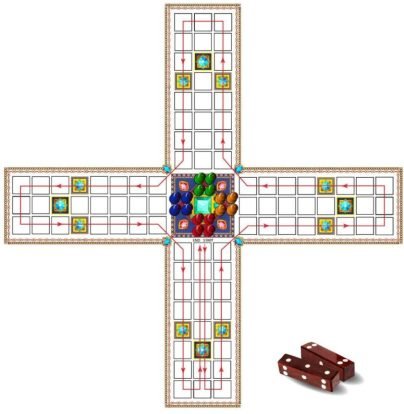
Moving path for all the red Gotis

Movement Rules

Once pieces are out:

  1. Move in an anti-clockwise direction, follow the outer path around the board.
  2. No backward movement, only forward
  3. You can move any piece; not required to move the same one every turn.
  4. Landing on the opponent’s piece, capture it and send the captured piece back to the Charkoni (the central square).
  5. The captured piece must re-enter with a fresh entry roll (6).

Safe Squares

  1. Some squares are safe spots (houses), where pieces cannot be captured.

Traditionally marked by different design or usually the cross- center intersections.

  1. If multiple pieces of one player are positioned on the same square → that becomes a safe block defending against capture.

Entering the Home Row

After completing one full circuit on the board, the piece reaches its home-entry row. The moves must be exact to reach the final home square.

If the dice roll score is more than required, you cannot enter the Charkoni, you must use that score to move another piece.

Winning the Game

The first player to bring all 4 pieces into the home square wins.

Example of Play Turn

If you roll the dice and you get a score of 4 + 2 = 6. If there is no piece on the board yet, you can bring one piece out.

On the next turn, you roll 3 + 5 = 8, then move your piece 8 steps ahead. If you land on any of the boxes with the opponent’s piece, you capture the opponent’s piece and it goes back to the Charkoni.

Winning

The first player to bring all four pawns to the hṛdaya-sthāna wins.

Notable Variations

  1. Pachisi: Cloth board, cowrie shells for scoring, complex scoring, and specific rolls needed to enter home. Highest score is 25 when all the 6 cowries fall inverted.
  2. Dayakattai (Tamilnadu): Wooden boards, cubical dice, and combination throws.
  3. Parcheesi (Western Adaptation): English Square board retaining few ancient complexities.
  4. Naalparam (Kerala): Different designs, possibly more pawns, and local strategic rules.

Educational value of the game

  1. Improves Strategy and Planning: Players must think ahead, decide moves wisely, and manage risks.
  2. Enhances Concentration: The game requires constant attention to the movement of tokens and the opponent’s
  3. Develops Patience and Sportsmanship: Players learn to wait for turns, handle setbacks, and respect rules.
  4. Strengthens Social Bonding: It is usually played in groups, encouraging conversation, cooperation, and shared
  5. Sharpens mathematical Thinking: Counting moves and calculating safe and risky positions improve basic math and logical reasoning.
  6. Cultural Awareness: Chaupad connects players with India’s traditional heritage and historical gaming

Modern Adaptations

Digital variants like Ludo King simplify Chaupad, removing safe zones and complex shell scoring. Yet the original Chaupad remains a treasured example of ancient Indian game-craft blending daiva and purushakāra (chance and effort).

Bharatiya Khel Program- An initiative by Indian Knowledge Systems (MoE)

India’s sports culture is thousands of years old, with countless games developed and played in the region.

Facebook Twitter Instagram Youtube

Explore

Home
Bharatiya Khel
Gallery
Blogs
Join us

Community

School of the month
Teacher of the month
Discussion Forum
Contact us

Address

011-29581005
khelbharatiya@gmail.com

Bharatiya Khel
Indian Knowledge Systems (IKS) Division
Ministry of Education (MoE),
Government of India,

Our office is located in
All India Council for Technical Education (AICTE)
Nelson Mandela Marg,
Vasant Kunj,
New Delhi-110070

Copyright 2024 by Bharatiya khel. Developed and Maintained By Explostack