Chaki badi
Traditional Sport of India
Chaki Khela / Chaki Badi
Chaki Badi is a traditional disc-and-stick game from Odisha, associated especially with tribal communities including the Juang people. It is played by striking a circular rubber disc called the chaki with a bamboo stick known as the badi.
Origin
Chaki Khela is one of the older traditional games played in parts of Odisha and is known among tribal communities, including the Juang tribe. It is also associated with areas such as Mayurbhanj, Keonjhar, and Dhenkanal, where related forms of the game became popular.
The game reflects local creativity, as the playing disc is often made from discarded slipper rubber and the striking stick from bamboo. This resourceful use of everyday materials gives the game both practical and cultural value.
About the Game
Chaki Khela is a team game in which players strike a rubber disc and try to send it across the field in a way that earns points. It combines strength, timing, coordination, and accuracy.
The game is usually played by children as well as adults and is often enjoyed during village gatherings and community recreation.
Before the Match
The Setup
Players
Usually 14 to 18 players, divided into two teams.
Team Size
Often 7 to 9 players on each team.
Play Area
A flat open ground divided into two courts by a midline.
Field Marking
The boundaries are marked at the corners, often using bamboo sticks.
Equipment
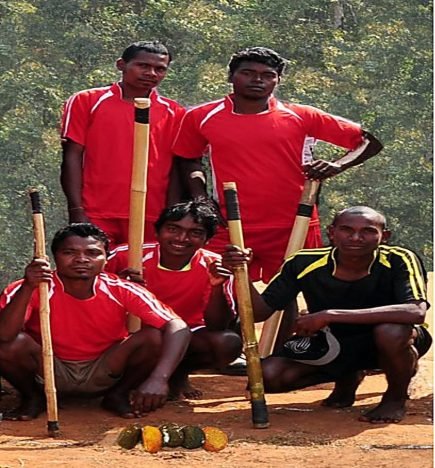
- Chaki: A circular rubber disc, often cut from the sole of an old slipper.
- Badi: A light bamboo stick, usually around waist height, prepared for grip and durability.
- Ground: A flat rectangular or square playing field with marked boundaries.
Together, the name Chaki Badi refers directly to the two main playing objects: the disc and the stick.
The Play
Playing Method
The team winning the toss begins the match by striking the chaki placed at the center line. A player uses the badi to hit the disc strongly and skillfully so that it travels toward or beyond the boundary.
The game rewards both powerful striking and controlled direction. Depending on how the chaki travels, different points may be awarded.
Starting the Game
- Players decide the first turn through a toss or simple counting method.
- The opening team places the chaki at the center line.
- A striker uses the badi to begin play with a forceful hit.
Basic Moves
- Striking the chaki toward the open field or boundary.
- Controlling direction and height for better scoring chances.
- Blocking or reacting to the disc in competitive situations.
- In some local variations, passing or retrieval elements may also be included.
Scoring
| Action | Points |
|---|---|
| Chaki crosses the boundary in the air | 6 points |
| Chaki rolls on the ground and crosses the boundary | 4 points |
| Chaki enters the striker’s own area before crossing out | Opponent gets 2 bonus points |
| Badi slips from the striker’s hands | Opponent gets 4 points |
| Chaki touches the striker’s body | Opponent gets a free hit |
Extra chakis may be kept ready in reserve in case the disc used in play is lost after a strong strike.
Winning
Teams continue play for the agreed duration, and points are added according to the results of each strike. The team with the higher score at the end of the match is declared the winner.
Variations
- Target-Based Play: Players aim at fixed targets such as stones or wooden blocks.
- Chaki Chase: Players race to retrieve the disc while opponents try to stop them.
- Relay Passing: Teams pass the chaki during a running circuit challenge.
Skills Developed
Physical Skills
- Hand-eye coordination.
- Agility and movement control.
- Strength and striking precision.
Social and Mental Skills
- Teamwork and coordination.
- Focus and timing.
- Confidence in competitive play.
Cultural Importance
- It shows eco-friendly use of discarded and natural materials.
- It strengthens community bonding during village gatherings and festivals.
- It preserves traditional tribal play practices and local identity.
Notes
Chaki Khela is an inventive and culturally meaningful game that reflects both recreation and resourcefulness. It stands as a strong example of how traditional communities create skill-based games from simple local materials.