Bandar killa
Traditional Sport of India
Bandar Khoonti
Bandar Khoonti, also known as Bandar Kila, is a lively traditional outdoor game from Punjab. It combines chasing, guarding, stealing, and quick movement in a playful group format.
Origin
Bandar Khoonti is a humorous and energetic traditional game associated with village life in Punjab. It was commonly played in open grounds, courtyards, and community spaces, especially during free time and festive gatherings.
The game reflects the lively social culture of rural Punjab, where children and youth enjoyed simple but engaging play using everyday objects. With only a pole, a rope, and footwear, the game remained accessible, entertaining, and socially bonding.
About the Game
The game revolves around one player acting as the Bandar, or monkey, who guards the footwear placed near a pole. The other players try to recover their shoes without getting tagged.
This creates a fun mix of defense, attack, distraction, timing, and speed. The game is playful in tone, but it also develops alertness, balance, and teamwork.
Objectives
For the Bandar
- Guard the footwear placed near the pole.
- Tag any player who comes close to steal it.
For the Other Players
- Steal back their footwear without getting tagged.
- Use timing and coordination to distract the bandar.
In Action
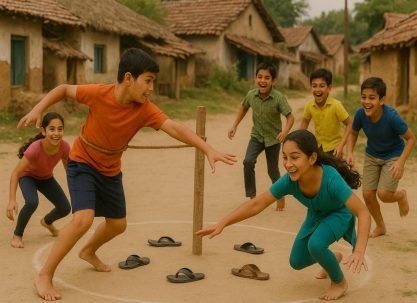
The Setup
Number of Players
Usually 5 to 10 players.
Main Equipment
A pole or tree used as the kila or fort.
Rope
A rope about 2 to 3 meters long to limit the bandar’s movement.
Play Objects
Players’ chappals, shoes, or similar personal objects.
The Play
- All players remove their footwear and place it near the base of the pole.
- One player is chosen as the bandar.
- The bandar is tied or linked to the pole with a rope that limits movement range.
- The remaining players stand at a short distance from the pole.
- On a signal, they rush in to grab their footwear while avoiding the bandar.
- The bandar tries to tag any player who comes within reach.
Rules
- The bandar guards the area around the pole where all footwear is kept.
- Other players must approach carefully and try to recover their own footwear.
- If the bandar tags a player, that player becomes the new bandar in the next round.
- If all players recover their shoes safely, the bandar may be given a playful penalty according to local custom.
- Any penalty or teasing should remain lighthearted, safe, and respectful.
Fun Penalty Variation
In some versions of the game, if the bandar fails to stop the players, they must hop on one leg to a pre-decided safe point. If they lose balance before reaching it, the others may jokingly tap or tease them using their recovered footwear.
This part should always remain playful and controlled, without roughness or harm.
Skills Developed
Physical Skills
- Agility and quick reflexes.
- Balance and leg strength.
- Speed and movement control.
Mental and Social Skills
- Strategy and timing.
- Teamwork and communication.
- Sportsmanship and resilience.
Safety and Fair Play
- The rope should not be too tight or dangerous.
- The ground should be flat, open, and safe for running.
- Players should avoid rough tagging or pushing.
- Any playful punishment should be harmless and supervised.
- Respect and fun should remain at the center of the game.
Cultural Value
Bandar Khoonti shows how simple village games can create excitement, laughter, and strong social bonds. It reflects the shared spirit of rural play, where imagination and everyday objects become part of traditional recreation.
Reviving such games helps preserve local heritage and reminds younger generations of the joy of community-based outdoor play.