A Che Che Sih Hlawk Ah – Mizoram
Traditional Sport of India
A Che Che Sih Hlawk Ah – Traditional Statue Game
A Che Che Sih Hlawk Ah is a traditional children’s game associated with Mizoram. It is a lively variation of the well-known statue game, where children run, freeze, and try to remain perfectly still when the caller turns around.
Origin
Traditional games of Mizoram reflect community life, playfulness, and social learning. A Che Che Sih Hlawk Ah is one such indigenous children’s game, usually played during leisure time in villages, schools, and open spaces.
It resembles the statue game found in many parts of India, although the rhyme, local name, and style vary by region. Similar versions are also mentioned in Arunachal Pradesh and Gujarat.
About the Game
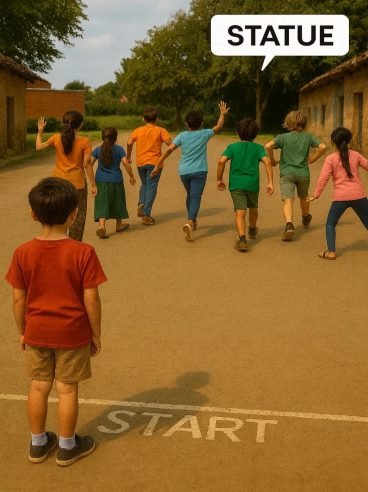
This is a simple group game of movement and sudden stillness. One child becomes the caller, the others move forward while the rhyme is spoken, and everyone must freeze the moment the caller turns and says “Statue”.
The game is enjoyable because it combines speed, alertness, discipline, patience, and humour.
The Setup
Equipment
None required.
Players
No fixed number; usually 6 to 15 children.
Play Area
Open ground, courtyard, or school playground.
Distance
Caller and group usually stand about 50–70 feet apart.
Accessibility
No special markings or equipment are needed, so the game is easy to organize anywhere.
The Play
- One child is chosen as the caller.
- The caller stands with their back to the other players, who line up at a distance.
- The caller chants the local rhyme while the other players move forward quickly.
- At any moment, the caller suddenly turns around and says “Statue”.
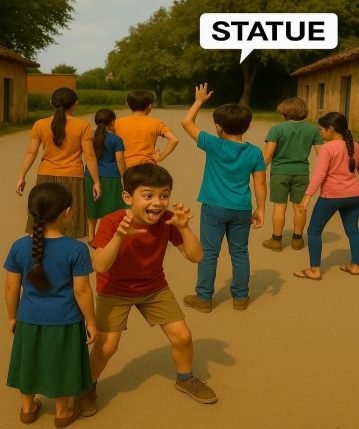
- All players must freeze immediately in the exact position they are in.
- No one should move, laugh, talk, or deliberately blink or fidget.
- The caller watches the players and tries to make them laugh or lose balance.
- Anyone who moves or laughs is declared out.
- The last player remaining still is the winner.
- In some versions, the first child who gets out becomes the new caller in the next round.
Caller Actions
The fun part of the game begins after everyone freezes. The caller may try to make the “statues” react in harmless and funny ways.
- Making funny faces.
- Telling jokes.
- Imitating animals.
- Dancing in a silly manner.
- Pretending to fall or act dramatically.
- Using only light, harmless gestures if local rules permit.
In Action
Group Play
Variations
Mizoram Version
In Mizoram, the game is known as A Che Che Sih Hlawk Ah, with local chanting lines that add rhythm and excitement to play.
Arunachal Pradesh Version
A similar version is referred to as Around the London. The structure remains similar, though the chant and playful punishments may vary.
Gujarat Version
In Gujarat, children may use the line: દોડો દોડો, ડુંગર ઉપર આગ લાગી… જે ભાગે તેનો જીવ બચે. The local rhyme gives the same basic game a distinctive regional flavour.
Rules
- Children must freeze completely when the caller turns around.
- Any movement, talking, smiling, or laughing can lead to elimination.
- The caller should observe fairly and announce who is out.
- The game continues until only one player remains.
- Local variations may decide whether the winner or first eliminated player becomes the next caller.
Scoring
There is no formal scoring system in this game. The winner is simply the player who remains still and serious for the longest time.
Benefits
Physical Benefits
- Improves body control.
- Develops balance and coordination.
- Encourages quick movement and stopping control.
Mental and Social Benefits
- Builds patience and alertness.
- Encourages discipline and self-control.
- Promotes group play and joyful social interaction.
Cautions
- Play in a safe and open area free from obstacles.
- Avoid rough pushing or harmful contact.
- Any playful punishment should remain harmless and optional.
- Ensure younger children are supervised during group play.