Ashta Kashte
Traditional Games of India
Ashta Kashte
Ashta Kashte is a traditional Indian board game of strategy and chance.
It is also known by regional names such as Koli kaDam and Champul,
and is played with pieces moved by cowrie shell throws.
Also Known As
Koli kaDam, Champul
Type
Traditional race board game
Players
2 to 4 players
Origin
Ashta Kashte is a traditional Indian board game with roots going back several centuries.
It has been associated with domestic play, courtly leisure, and regional board-game traditions
in different parts of India.
The name is linked to the special throw value of eight, obtained when the cowries produce
the highest-value result. The game is often discussed alongside other Indian race games and
is sometimes considered related to the wider family of games that includes Pachisi, though
that ancestry is often described as speculative rather than fully proven.
About the Game
Ashta Kashte combines counting, planning, and luck. Players move their pieces around a marked
square board, first around the outer path and then inward toward the center.
Since movement depends on the throw of cowrie shells, chance plays a role, but players must
still decide carefully which piece to move and when to advance, capture, or stay safe.
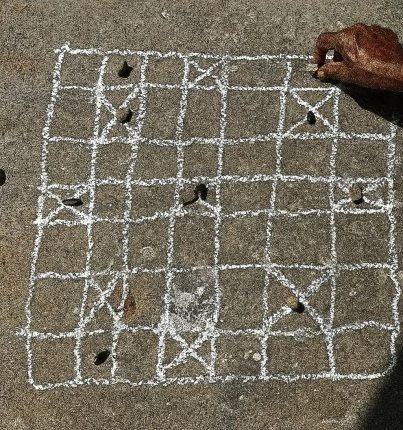
Traditional Board
Playing Arrangement
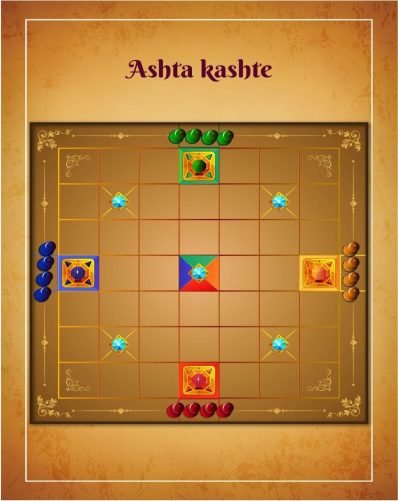
The Setup
The Game Board
The game is played on a square board divided into a 7 × 7 grid, making 49 smaller squares.
The central square and the middle square on each outer side are specially marked.
The center is the final destination or home, while the four outer marked squares serve as
starting and resting points for the players.
Players and Equipment
| Element | Description |
|---|---|
| Number of Players | 2 to 4 |
| Pieces per Player | 4 pieces, usually in different colors or forms |
| Dice Used | 4 cowrie shells |
| Normal Throw Values | Based on the number of cowries landing mouth-up |
| Special Throw | Eight or grace, which gives an extra turn |
The cowries are shaken in the hand or a small cup and then cast onto the playing surface.
Their upward or downward positions determine the movement count.
Movement Path
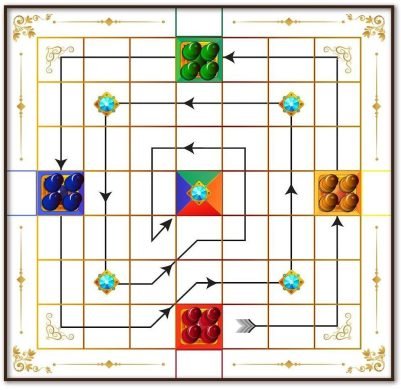
The Play
Entering the Board
- A player brings a piece into play only after a grace throw.
- The piece enters from the marked square on that player’s side of the board.
- A player may sometimes choose not to use a throw for strategic reasons.
Movement
- Once on the board, pieces move anti-clockwise along the outer track.
- After completing the outer circuit, the piece turns inward through the designated path.
- Movement then continues along the inner path toward the center.
- The aim is to reach the central square with an exact throw.
Capturing Opponents
- If a piece lands on a square occupied by an opponent, that opponent’s piece is captured.
- The captured piece is removed from the board.
- The capturing player earns an extra throw.
- Pieces on marked resting squares are safe and cannot be captured.
Grace Throws
- A grace throw gives the player an additional turn.
- The extra turn may be used to enter a new piece or move an existing one.
Re-entry
- If the starting square is occupied, special local rules may allow replacement of the opponent’s resting piece.
- Players must balance attack, defense, and safe progression toward home.
Reaching the Center
- A piece must enter the center by exact count.
- The first player to take all four pieces to the center wins the game.
Example of Play
If a player throws three, one active piece moves three spaces along its designated path.
On a later turn, if the player throws a grace, they may either bring a new piece into play
or move an existing one and take another throw.
Skilled players often decide carefully whether to introduce new pieces early or advance only
a few pieces safely toward the center.
Significance and Symbolism
- The inward spiral toward the center can be seen as a symbolic journey toward fulfillment.
- The changing directions of movement suggest a balance between chance and choice.
- The grace throw reflects the idea that fortune can suddenly alter progress.
Traditionally, the game was played in homes and social gatherings, especially during leisure time,
and it helped build patience, calculation, and decision-making.
Relation to Other Games
| Game | Region | Similarity |
|---|---|---|
| Pachisi | North India | Uses cowries and race-style movement; often discussed as related [web:41] |
| Chowka Bhara | Karnataka | Comparable use of cowries, path movement, and special throws [web:36] |
| Ashtam Changam | South India | Another regional variant in the same broad game family [web:32][web:46] |
| Champul / Koli kaDam | Other Indian regions | Regional names associated with the same or closely related game [web:32][web:44][web:46] |
Educational Value
Skills Developed
- Counting and probability awareness through cowrie throws.
- Planning and logical sequencing.
- Decision-making under uncertainty.
- Patience and strategic thinking.
Cultural Learning
- Introduces indigenous Indian board-game traditions.
- Shows how play and symbolism can exist together.
- Helps preserve regional names and cultural memory.