Kooka kanghrhey (Punjabi: ਕੂਕਾਂ ਕਾਂਘੜੇ)
Traditional Games of India
Kooka Kanghrey / Patt Patteellay
Kooka Kanghrey is a traditional team game from Punjab that turns ordinary village spaces
into arenas of strategy, memory, observation, and playful competition. Played without
special equipment, it relies on hidden lines, quick thinking, teamwork, and sharp visual attention.
Region
Punjab
Also Known As
Kooka Kanghrey, Patt Patteellay
Type
Traditional team strategy and observation game
About the Game
Kooka Kanghrey is a traditional rural Punjabi game played mainly by children and youth in lanes,
courtyards, and open village spaces. It is based on creating hidden lines or patterns and then
searching for them before the opposing team can find them all.
The game emphasizes memory, cooperation, disguise, and observation rather than strength or equipment.
Its rhythmic call gives the game a musical and communal character.
Origin
Kooka Kanghrey belongs to the traditional village play culture of Punjab, where children used
everyday surroundings as part of their games. Courtyards, narrow lanes, walls, dust, and ground
surfaces became natural spaces for imaginative and strategic group play.
The game reflects a style of life in which creativity, teamwork, and local space were closely connected.
It remains a strong example of indigenous intelligence-based play in rural India.
The Setup
Equipment Needed
No compulsory equipment is needed, though chalk, a stick, or a small stone may be used
to draw lines or patterns on the ground or walls.
Players
There is no strict player limit, but the game is usually played by 8 to 20 players divided
equally into two teams.
Team A
The Owners or Defenders who create the hidden lines.
Team B
The Seekers who search for the hidden lines.
Age Group
Generally suitable for children aged 6 years and above.
Game Style
Turn-based team strategy with role switching across rounds.
The Playground
The game is played in a lane, courtyard, or open village street.
The playing area is divided into two equal halves, one for each team.
Each team uses its own half to create hidden lines or patterns, while the center acts
as the meeting and starting point.
Play Area
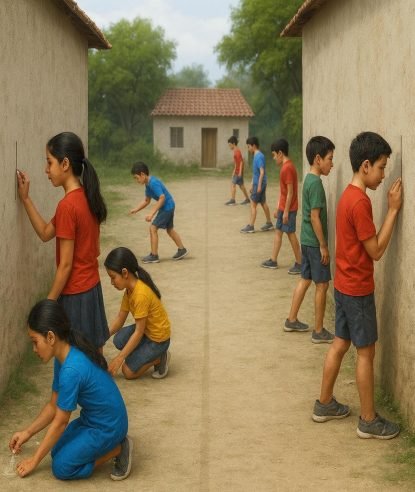
The Play
Part 1 – Creating the Lines
- Both teams gather at the center line.
- A player announces the start with the call “Kooka Kanghrey” or “Patt Patteellay.”
- Both teams rush to their own halves and quickly draw hidden lines or patterns.
- Lines may be straight, curved, zigzag, or blended into the surroundings.
- When a team finishes, one player returns to the center and calls out again to stop all drawing.
Part 2 – Searching for Hidden Lines
- The teams switch sides and move into the opponent’s half.
- The seekers search carefully for hidden lines or patterns.
- Each discovered line is marked by drawing a crossing line over it.
- The defenders may distract or mislead through words or movement, but cannot interfere physically.
Searching Stage
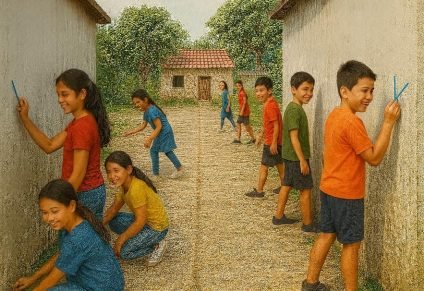
Scoring and Winning
After the search ends, both teams return to the center and count the results.
- Lines discovered and crossed out by the opponents.
- Lines left undiscovered and unmarked.
- The team with the higher number of undiscovered lines wins the round.
- Multiple rounds may be played with teams switching roles.
Rules
- Teams may draw as many lines as they wish, but only within their assigned half.
- All lines must be drawn within the allowed time.
- No physical blocking or covering is allowed once the search starts.
- Players must not cross into the other half before the signal.
- Disputes should be settled by mutual agreement or by a neutral referee.
Strategies to Win
For Defenders
- Hide lines within dust, cracks, uneven ground, or textured walls.
- Avoid obvious or symmetrical patterns.
- Divide the area among team members for faster and wider coverage.
For Seekers
- Study light, surface texture, and color differences closely.
- Spread out carefully to cover more ground.
- Communicate discoveries clearly to avoid repeating the same search areas.
Cautions
- Choose a traffic-free and safe lane or play area.
- Use non-toxic materials such as chalk or mud for drawing.
- Avoid slippery, broken, or uneven surfaces.
Cultural Significance
Kooka Kanghrey reflects the shared life of Punjab’s villages, where everyday spaces become
places of creativity, strategy, and community participation. The game shows how mental alertness
and cooperation can be as valuable as physical strength.
Often played in the evenings or after busy agricultural seasons, it brings laughter, competition,
and togetherness to both children and adults.
Life Lessons and Skills Developed
Mental Skills
- Observation and pattern recognition.
- Analytical thinking and decision-making.
- Creativity in hiding and searching.
Social Skills
- Team coordination and planning.
- Respect for rules and fair play.
- Cooperation and group discipline.
Educational Value
Kooka Kanghrey can be introduced in schools as an indigenous Indian strategy game that promotes
attention, teamwork, and cultural awareness. It offers a strong example of how traditional play
can support both mental development and heritage education.