Raja Mantri Chor Sipahi / Ram Laxman Seeta Devi
Traditional Games of India
Raja Mantri Chor Sipahi
Raja Mantri Chor Sipahi is a traditional Indian social guessing game built around hidden roles,
deduction, bluffing, and playful suspense. In this seated version, players use paper chits to
assign roles, making it an easy indoor game that combines strategy, observation, and fun.
Also Known As
Raja Mantri Chor Sipahi, Ram Laxman Seeta Devi
Type
Traditional indoor role and guessing game
Main Skills
Bluffing, deduction, observation, and social play
About the Game
Raja Mantri Chor Sipahi is a classic Indian role-based game in which players secretly receive
identities and then try to detect or conceal the Chor, or thief.
This seated version is simpler than the running outdoor version and is usually played indoors
in a circle or around a table. It is especially popular because it needs almost no equipment
and works well for both children and mixed groups.
Traditional Group Play
Objective
The main objective is to identify who among the players is the Chor.
The game revolves around hidden identity, guessing, and controlled bluffing.
What You Need
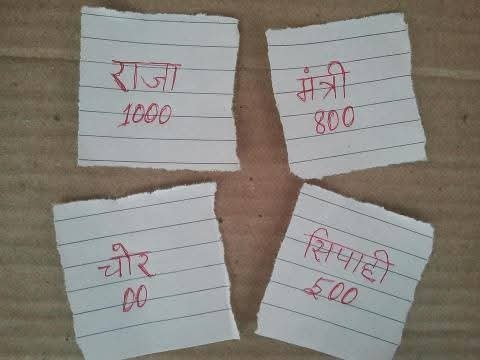
- Small paper chits with roles written on them.
- At least 4 players, though 6 to 10 players make the game more lively.
- A seated arrangement, such as a circle or table setting.
Roles on the Chits
- Raja (King)
- Mantri (Minister)
- Chor (Thief)
- One or more Sipahi (Soldier), depending on the number of players
Role Distribution
All chits are folded, shuffled, and placed together so that no role is visible.
Each player picks one chit randomly and keeps the role secret.
Point Values
| Role | Points |
|---|---|
| Raja | 1000 |
| Mantri | 800 if correct, 0 if wrong |
| Chor | 0 if identified, 500 if not identified |
| Sipahi | 500 |
Gameplay Instructions
- All players first receive their hidden roles.
- The Raja reveals their identity to the group.
- The Raja then calls on the Mantri to identify the Chor.
- The Mantri points to the player they suspect is the Chor.
- After the guess, all players reveal their roles.
- Points are awarded according to the result of the guess.
Scoring
- The Raja always receives 1000 points.
- The Mantri receives 800 points for a correct guess and 0 for a wrong guess.
- The Chor scores if they remain unidentified.
- The Sipahi receives the fixed score used in the chosen rule version.
After each round, the chits are reshuffled and redistributed so that players get different roles over time.
Winning the Game
The game is usually played for a fixed number of rounds, such as 5 or 10.
At the end, each player adds their total points, and the highest scorer wins.
Social Play Variation
Some groups add a more dramatic version in which players speak softly, observe behavior,
and try to detect the Chor through gestures, reactions, or subtle movements.
In this variation, the Raja may ask questions, the Sipahi may watch for suspicious behavior,
and the Chor tries to remain unnoticed through acting and self-control.
Game Variations
- Use multiple Sipahi for larger groups.
- Play silent rounds where players rely only on expressions and gestures.
- Use themed names such as Ram, Laxman, Seeta, and others in local versions.
- Change the point system to suit the age group or speed of play.
Skills Developed
Mental and Social Skills
- Improves observation and attention to behavior.
- Builds critical thinking and deduction.
- Encourages bluffing, self-control, and quick judgment.
Group Benefits
- Promotes interaction and laughter in a group.
- Works well as an icebreaker at gatherings.
- Encourages turn-taking and fair play.
Cultural Significance
Raja Mantri Chor Sipahi has been played across generations in India as a lively social game
that mixes role-play with wit and deduction.
Its symbolic characters represent authority, guidance, mischief, and protection,
turning a simple chit game into a playful reflection of social roles and storytelling traditions.