Santhal katti
Traditional Games of India
Santhal Kati
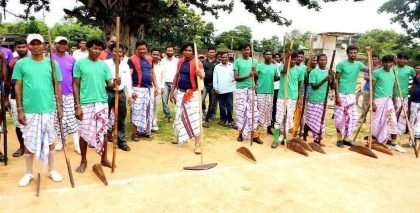
Santhal Kati is a traditional team game associated with the Santhal and Bhumij communities of Odisha.
It combines strength, sharp aim, foot coordination, and tactical striking, while also carrying strong ties
to harvest-time gathering and community celebration.
Region
Odisha
Communities
Santhal and Bhumij
Type
Traditional striking and target team game
About the Game
Santhal Kati is a traditional outdoor game in which players use a bamboo rod to strike a wooden kati
and aim it toward the opponent’s arranged pieces. The game demands precise observation, strong footwork,
and controlled movement, making it both physically challenging and tactically engaging.
Traditionally, it was played as a community activity after the harvest season.
In that setting, the game became part of social gathering, celebration, and shared identity.
Before the Game
Origin
Santhal Kati is rooted in the indigenous play traditions of tribal communities in Odisha,
especially among the Santhal and Bhumij people. In these communities, games often carried social,
ritual, and cultural meaning beyond recreation.
Kati was reportedly played during festivals and special occasions, and in older village traditions,
the outcome of a team’s performance could even influence important social matters. This shows how closely
the game was tied to community honor and collective life.
The Setup
Players
The game is usually played between two teams of nine players each.
Equipment
Kati
Each player has a kati, a half-moon-shaped wooden disc, traditionally made from tamarind wood.
Earlier, katis varied in size, but later they came to be made in more fixed dimensions and heavier forms.
Tarhi
A tarhi is a long bamboo rod, usually around 6 to 7 feet in length,
used as the striking implement.
Playground
The field is rectangular in shape, with a central line drawn parallel to the shorter sides.
A wooden log called the bergha is placed at the midpoint of this central line.
Two additional parallel lines are marked on either side of the center line.
These help define the main striking and target area used during play.
The Play
The main objective of the striking team is to send its kati toward the defenders’ side
after successfully striking the opponent’s kati placed on the middle line.
- The defending team places its katis in a row along the midline.
- The striking team lines up near the boundary with its own kati and tarhi.
- A player grips the tarhi and kicks or propels its lower part so that it hits the player’s kati.
- The kati is then driven forward to collide with the opponent’s kati.
- Players take turns, and if one player fails to hit properly, the turn passes to the next player.
A major part of the game lies in deciding the angle, force, and direction of the strike.
Scoring
Points are awarded when a player successfully strikes the opponent’s kati and displaces it.
In many versions, the game continues until one of the teams reaches 7 points.
Some local variations may count points differently depending on distance or final position,
but successful striking and displacement remain central to scoring.
Winning
A key stage toward victory comes when a hit sends the kati beyond the line on the other side of the center.
From there, the player may continue striking other katis in sequence.
In the final stage, a successful player may need to strike from where the kati has fallen in such a way
that it hits the bergha, completing the path to ultimate victory.
Skills Required
Physical Skills
- Strong leg power to propel the strike effectively.
- Firm grip and control over the bamboo tarhi.
- Quick footwork and body balance during the action.
Game Skills
- Keen eyesight and accurate aim.
- Judgment of angle and force.
- Practice-based precision and tactical placement.
Cultural Significance
Santhal Kati is not just a competitive game; it is also a cultural expression of communal life,
seasonal celebration, and tribal identity. Its continued memory reflects how traditional games
strengthen social bonds and keep collective heritage alive.
Through shared play, the game preserves values of teamwork, endurance, and respect for tradition.
Note
Santhal Kati stands out as a powerful example of Odisha’s indigenous sports heritage.
With simple materials but deep skill and symbolism, it remains a meaningful blend of athletic challenge and community tradition.